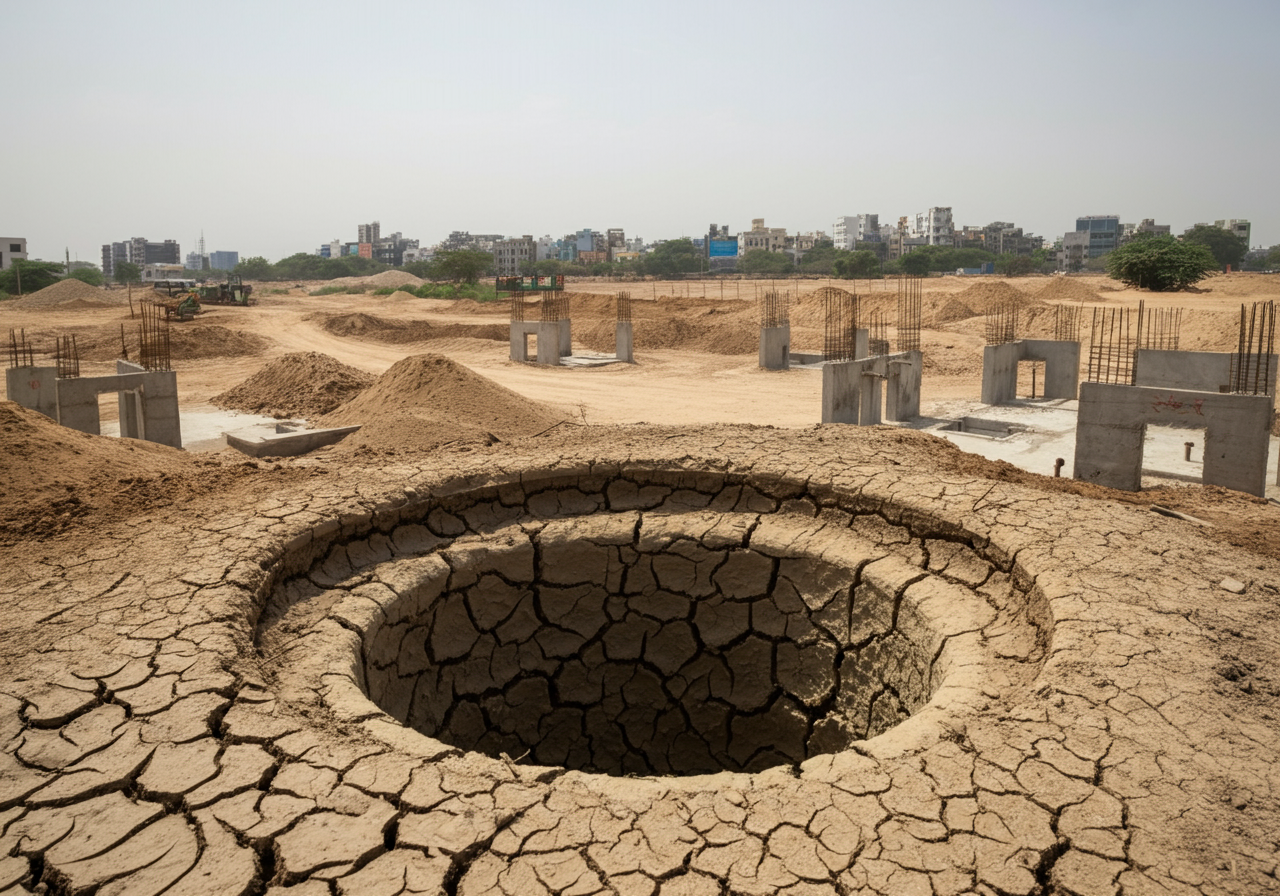
HYDERABAD: Hyderabad has become India’s most severely affected metro in terms of groundwater depletion, according to the Dynamic Groundwater Resource Assessment Report 2025 published by the Union Ministry of Jal Shakti. It surpasses even Delhi and Mumbai, which are larger urban centers.
Within Greater Hyderabad, 26 mandals and tehsils—areas which include parts of Rangareddy and Medchal-Malkajgiri districts—are categorized as “critical” or “over-exploited” in groundwater extraction, the highest of any major Indian city. For comparison, Delhi has 21 such units despite a population of 3.3 crore, nearly three times that of Hyderabad. Bengaluru, a city similar in size, only has 16 units in these categories.
The prevalence of “critical” and “over-exploited” groundwater zones in Greater Hyderabad exceeds that of large states such as Andhra Pradesh, Bihar, and Maharashtra, which have fewer affected units.
The Central Ground Water Board classifies regions based on their groundwater extraction rates: areas extracting less than 70% are deemed “safe,” those between 71% and 90% are “semi-critical,” while 90% to 100% falls under “critical,” and above 100% is labeled “over-exploited.”
The urgency of the situation is particularly pronounced in Hyderabad district, where none of the 16 units qualify as “safe.” Only one is “semi-critical,” while the remaining 15 are either “critical” or “over-exploited,” indicative of unsustainable groundwater extraction. Areas like Khairatabad, Ameerpet, and Serilingampally are among those severely impacted.
Officials attribute this crisis to excessive borewell drilling and rapid urban development spanning nearly 2,000 square kilometers in Greater Hyderabad.
Excessive Drilling, Poor Recharge
“Only about 15% of the city is equipped with rainwater harvesting systems,” explained K Laxma, director of the Telangana Groundwater Department. “Although Hyderabad receives 900 mm to 1,000 mm of rainfall annually, much of it runs off due to the lack of open spaces for groundwater infiltration.”
Laxma cautioned that unchecked groundwater extraction is causing water tables to drop each year. “With proper maintenance of rainwater harvesting systems, groundwater levels can remain within a depth of 10 meters. Without these measures, levels are dropping beyond 20 meters,” he added.
Better Management in Other Metros
Experts note that cities like Bengaluru have managed to mitigate groundwater stress through the establishment of thousands of percolation wells. These wells can reportedly harvest over 100,000 liters of rainwater annually.
In contrast, Delhi has improved its groundwater management through stricter regulations on illegal extraction and better access to piped water.
Rocky Terrain, A Challenge
Hyd Hyderabad’s unique geological structure poses additional challenges. Unlike cities with softer soil, such as Mumbai or Bengaluru, Greater Hyderabad is primarily situated on rocky ground, complicating natural rainwater absorption. This issue is exacerbated by the ineffective implementation of rainwater harvesting practices, according to B Venkateswara Rao, a retired professor at JNTUH’s Centre for Water Resources.
Illegal Borewells Add Pressure
Officially, Hyderabad district has about 250,000 borewells, but estimates suggest that the actual number could be much higher, as many borewells are installed without proper permits. The total for Greater Hyderabad is thought to be around 1 million.
Legislation such as the Water, Land and Trees Act (WALTA), 2002, restricts borewell drilling to depths of 400 feet. However, many operators continue to drill illegally to depths exceeding 1,000 feet.
Officials have also criticized borewell companies for misleading consumers regarding water availability at greater depths, a practice that has critically undermined the city’s groundwater resources.