

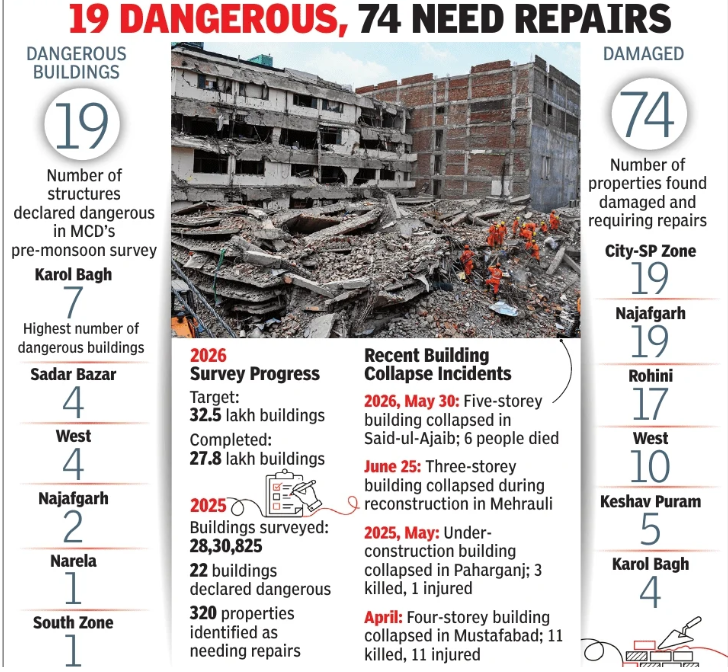
NEW DELHI: The Municipal Corporation of Delhi (MCD) has identified just 19 dangerous structures among nearly 28 lakh buildings surveyed so far during its annual pre-monsoon inspection, raising concerns about the exercise’s effectiveness.
Although the survey typically wraps up by June 15, MCD claims it has completed around 85% of the task, inspecting approximately 27.8 lakh properties against a target of 32.5 lakh for this year.
This survey, which spans 3-4 months, is executed annually before the monsoon by teams from the buildings and maintenance departments. If initiated in March, at least 30,000 buildings would need to be surveyed daily.
This year’s findings include seven dangerous buildings in the Karol Bagh zone, four in Sadar Bazar, four in West zones, two in Najafgarh, and one in each of Narela and South zones.
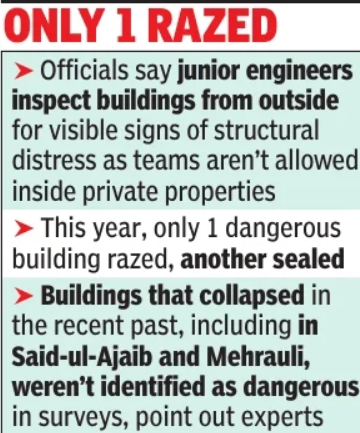
According to MCD reports, one hazardous structure in Karol Bagh has been demolished by its owner, while one in the South zone has been sealed. However, further action on the remaining unsafe buildings remains pending.
In addition to the dangerous buildings, 74 others require repairs or retrofitting. Notices have been issued to their owners, yet none have been addressed to date.
“This pre-monsoon survey starts three to four months prior to the rainy season, involving hundreds of officials from maintenance and buildings departments,” stated an MCD official.
Officials acknowledged that inspections are primarily based on external visual assessments since teams generally cannot enter private properties. “The survey focuses on visible signs of structural distress such as cracks and sagging, and a detailed audit occurs only if necessary,” an official added.
“Each ward has around 15-20 staff members contributing to this survey,” another official noted.
However, structural experts have raised concerns about both the methodology and the scale of the inspections. Aditya Sharma, a structural engineer, stated: “Even if we accept that MCD’s survey is visual, it still requires substantial time to assess buildings. Determining whether a crack is simply on the surface or indicative of deeper structural issues requires expertise. Even with 1,000 trained personnel, covering 28 lakh buildings would take approximately 1,400 working days, making MCD’s figures hard to believe.”
Residents have also critiqued the effectiveness of external inspections, especially in densely populated areas.
A Malviya Nagar resident remarked, “In many Delhi areas, multi-storey buildings are squeezed into narrow lanes, making it nearly impossible to conduct a thorough assessment from the outside.”
Notably, several buildings that collapsed in recent years, including those in Said-ul-Ajaib and Mehrauli, had not been flagged as dangerous, underscoring the inspection’s limitations.
Atul Goyal, president of United Residents Joint Action (URJA), stated that these incidents highlight the flaws in the current inspection process. “Many collapses in the south and northeast regions in 2025 and 2026 were due to owners making alterations without reinforcing load-bearing structures. Buildings that were permitted as ground-plus-two under MPD-2007 have often been expanded to four storeys under MPD-2021 without structural safety certificates,” he noted.
The MCD asserted that they have taken action against unauthorized constructions following recent building collapses and fire incidents this year.