

India’s office market is experiencing a significant shift. Developers, institutional investors, and REIT-backed platforms are increasingly opting for leasing arrangements instead of selling assets, reshaping the commercial real estate landscape and reducing the availability of premium office spaces across the country’s leading property markets.
Data from CRE Matrix reveals that single owners and REITs collectively account for 72% of the nation’s 1,085 million sq ft ready office inventory, with properties under multiple ownership structures comprising 27% of the total stock.
The trend is evident in the 550 million sq ft of planned or under-construction inventory, where 61% is managed by single owners and REITs, thus limiting the availability of premium office assets for direct acquisition.
“Outright acquisitions remain appealing, especially for Grade A and A+ properties in prime areas, as ownership provides better operational control and long-term yield potential for high-net-worth individuals (HNIs) and ultra-HNIs looking to establish rental portfolios. Nevertheless, the pool of marketable assets in this category is narrowing, as REITs and institutional investments gain traction, leading more developers to retain office assets and build annuity portfolios,” explained Abhishek Kiran Gupta, Co-Founder & CEO of CRE Matrix.
Demand for direct office acquisitions persists, driven by occupiers seeking strategic assets, family offices looking for stable income-generating properties, and high-net-worth investors diversifying away from residential real estate.
“The buyer demographic in the wholesale office market has expanded significantly over recent years, thanks to stable yields, quality assets, and long-term value appreciation. Beyond occupiers, we observe increased interest from family offices and private investors who view office properties as a stable income-generating asset class with lower volatility and stronger governance compared to many alternative investments. Some affluent buyers are also considering acquiring assets to retrofit them for enhanced yield,” noted Viral Desai, International Partner & Senior ED at Knight Frank India.
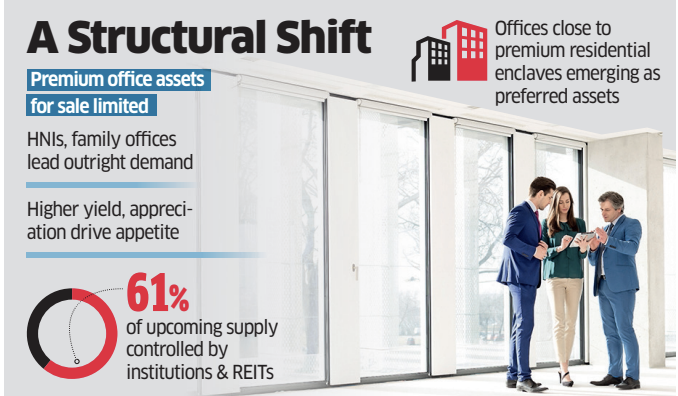
The trend is also reflected in Mumbai’s luxury residential market, notably in South and Central Mumbai, where ultra-high-net-worth individuals and business families are increasingly viewing commercial real estate as an extension of their investment portfolios. Offices situated near premium residential areas are becoming favored assets, though the availability of institutional-grade properties on the market remains limited.
While leasing continues to dominate India’s office market, outright ownership is still vital for various investor and occupier categories. The restricted availability of institutional-grade assets for sale is significantly influencing transaction dynamics, with access to quality inventory being a crucial market differentiator.
Industry experts predict that the mismatch between buyer interest and the number of quality assets will keep outright office transactions concentrated on select opportunities, especially in regions like Bengaluru, Mumbai, Hyderabad, Pune, and the National Capital Region, where occupier demand and leasing activity remain robust.