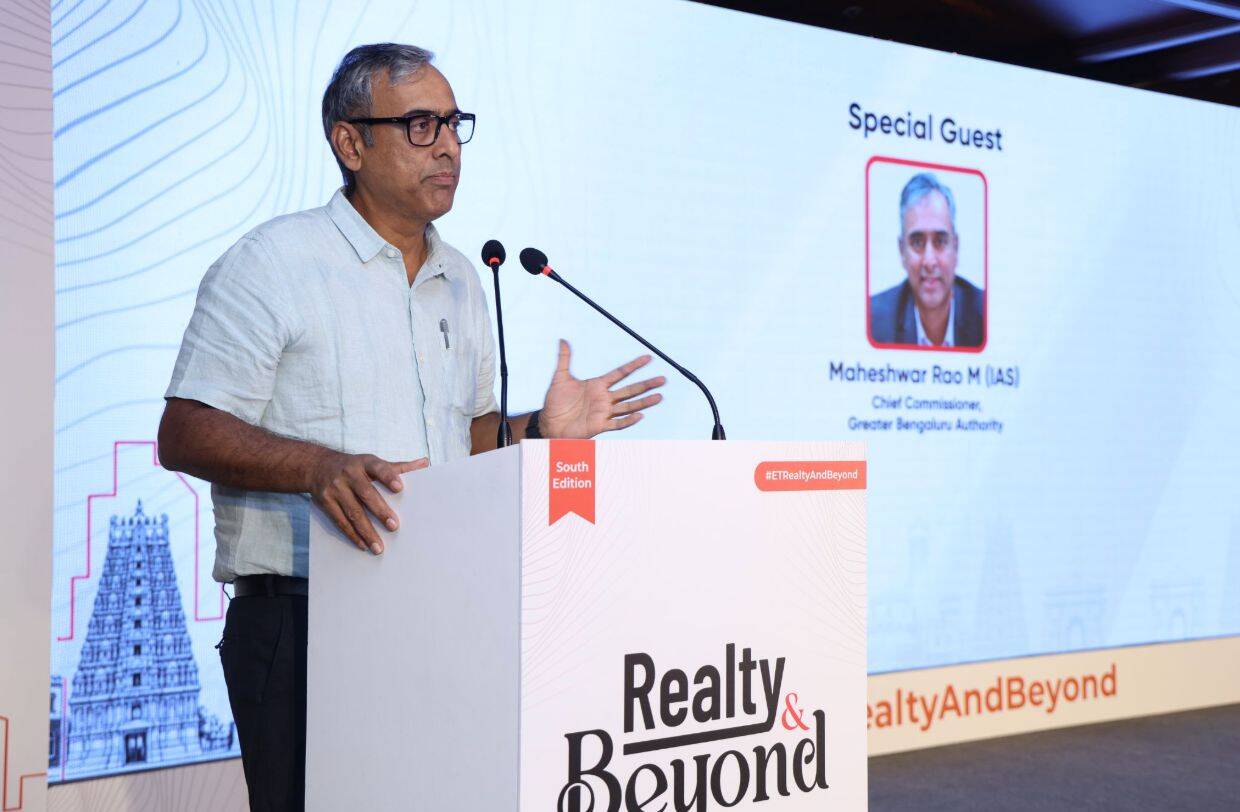
As Bengaluru embarks on its next urban expansion phase, Maheshwar Rao M (IAS), the Chief Commissioner of the Greater Bengaluru Authority (GBA), emphasizes the necessity of planned development over haphazard growth.
During a talk on Tuesday, Rao highlighted that the city’s population is projected to grow sharply in the upcoming decades, making integrated urban planning, housing, transportation infrastructure, and public spaces vital to sustaining economic growth.
Rao shared these insights at the RealtyDailyNews Realty & Beyond Summit in Bengaluru, attended by developers, policymakers, consultants, and industry stakeholders focusing on real estate and urban development in Karnataka.
Referring to Bengaluru’s rapid transformation in the past twenty years, Rao noted the population has escalated from roughly 8 million to about 14 million. Looking ahead, he mentioned that the metropolitan area could witness even more significant population increases by 2030 and beyond, underscoring the need for a systematic growth strategy.
He asserts that Bengaluru will remain a major talent hub in India, despite shifts in employment trends, due to its robust ecosystem of jobs, innovation, and availability of skilled labor.
“Bengaluru will continue to attract significant talent,” Rao remarked, indicating that ongoing migration will drive demand for housing, infrastructure, and urban services.
Looking toward the future of real estate, Rao identified northern Bengaluru as a key growth area in the coming years, while also mentioning new urban centers being planned beyond the city limits.
“The eastern and northern regions of Bengaluru have been significant growth drivers, with northern Bengaluru currently spearheading a substantial upsurge in real estate,” he explained. Rao also disclosed government evaluations for developing Bidadi as a planned township, which aligns with a strategy to create new growth centers backed by strong connectivity infrastructure.
The Chief Commissioner announced that the state government has started developing a long-term economic master plan that will lay the groundwork for Bengaluru’s revised spatial development framework. This initiative will address future needs regarding transportation, water resources, road infrastructure, and urban densification.
He underscored that today’s planning decisions will shape the city’s capacity to meet future residential demand while preserving quality of life.
“We need to create spaces that are good for working, living, and public use,” Rao stressed, highlighting the importance of balancing economic growth with urban livability.
On transportation, Rao pointed out the extensive public investments targeting Bengaluru’s persistent traffic congestion issue. The state is significantly investing in transportation infrastructure while also enhancing road networks and connectivity in emerging growth sectors.
He further outlined initiatives aimed at expanding road widths in key development areas identified in the revised master plan, especially in eastern, southern, and northern Bengaluru, where rapid real estate development often exceeds infrastructure growth.
Beyond transportation, Rao indicated an increasing focus on walkability and public space enhancements to foster urban quality of life.
“We aim to make the city more pedestrian-friendly,” he noted, mentioning that funds have been allocated by civic agencies for improving sidewalks and enhancing public space usage.
Rao also highlighted the introduction of the e-Khata system as a pivotal reform intended to boost transparency and simplify property transactions. He explained that most legacy property records are now digitized, with efforts underway to develop a more user-friendly version based on stakeholder input.
In closing, Rao called on developers and real estate professionals to remain engaged in Bengaluru’s long-term growth narrative, emphasizing that collaboration between the government and industry is essential for establishing a more sustainable, future-ready metropolis.