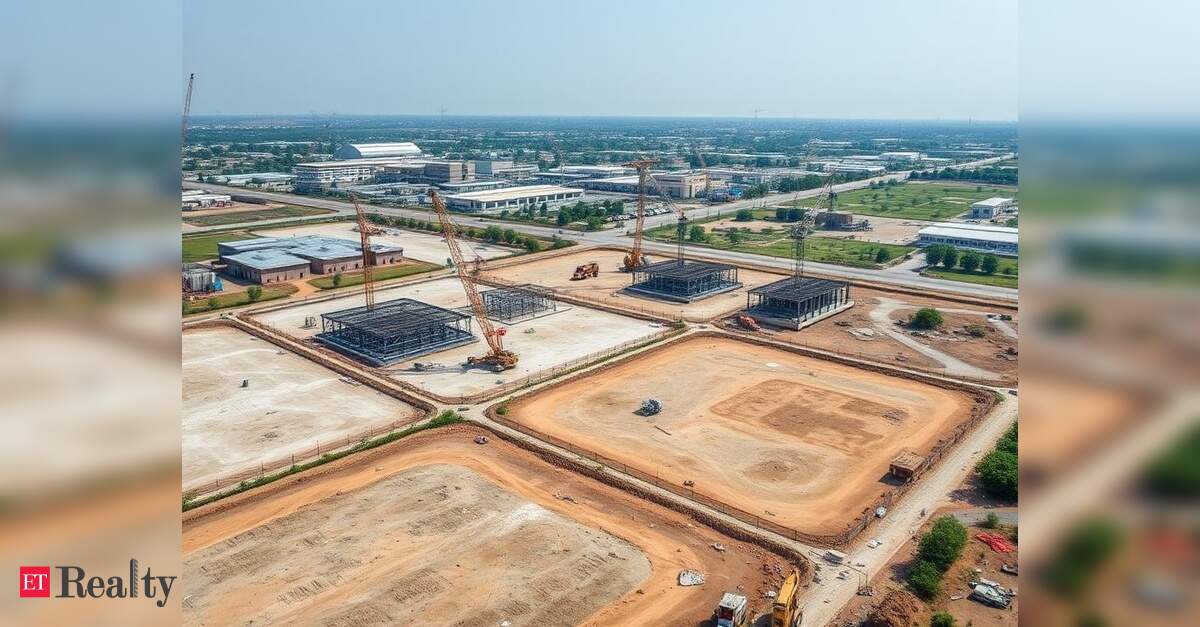

NOIDA: The Uttar Pradesh government has released a draft unified building code aimed at significantly altering project developments in Noida, Greater Noida, Yamuna, and other industrial development areas.
The new regulations propose to consolidate separate rules for each development authority into a singular comprehensive framework. They also aim to increase floor area ratio (FAR) limits across various categories, link higher FAR to the width of adjacent roads, reduce setback requirements, and eliminate height restrictions except where safety or heritage guidelines apply.
The draft of the Unified Building Regulations for Industrial Development Authorities is now available for public comment on the Nivesh Mitra portal. Officials noted that it will be applicable to Noida, Greater Noida, Yamuna Expressway, UPSIDA, UPEIDA, and any future industrial development authorities. A representative from the Noida Authority mentioned that feedback can be submitted in person or via mail over the next 15 days, during office hours.
Shailendra Bhatia, additional CEO at Yamuna Expressway Authority, stated that the draft has been distributed to all relevant authorities as well as the public. “After gathering objections and suggestions, we will finalize and implement the draft regulations,” he added.
The most significant change pertains to FAR, which dictates the allowable built area on a plot. Previously, each authority had its own limits and discretionary power regarding FAR, setbacks, ground coverage, and height. Currently, industrial plots typically have an FAR ranging from 0.6 to 2, group housing from 2.75 to 3.5, institutional projects from 0.8 to 2.75, and commercial developments from 1.2 to 4.
Under the draft, FAR increases and is directly correlated to road width. For industrial plots on roads measuring 12m-24m, the base FAR is set at 3, with potential increases to 6. On roads 24m-45m, the base remains 3, but the maximum can rise to 10.5. For roads wider than 45m, the base FAR stays at 3, with no upper limit. In group housing projects, the base FAR is proposed to be 3.5, with possible increases up to 7 or even 10.5 depending on road dimensions.
This essentially means that wider roads will accommodate denser development. PPS Nagar, a lawyer specializing in land deeds, explained, “Plots with higher FAR will house greater density and thus require broader roads, as a dense population cannot be sustained on narrow roads. It’s directly proportional.”
The draft also reduces setback requirements, allowing for more usable land within plots. Prior regulations limited ground coverage, imposing setbacks of up to 16m in the front and 12m on each side and rear. For group housing, ground coverage was about 35%-40%, and in industrial areas, it ranged from 35%-60%.
Under the new proposal, the required setback is 9m in front and 6m on the other three sides, defining the minimum open space between a building and the plot boundary.
Credai West UP president Dinesh Gupta termed the changes as positive, noting, “Noida and Greater Noida had strict FAR regulations, while some agencies like Awas Vikas had already updated their norms to allow for greater FAR. This initiative will encourage vertical development instead of horizontal expansion,” he remarked.
The adjustment in setback requirements reflects the reality of limited land availability in urban settings.
The draft also mandates open-space requirements for larger layouts. Developments over 3,000 sqm must allocate land for parks — 15% of total area for residential projects and 10% for non-residential. Projects below 3,000 sqm will not require designated parkland.