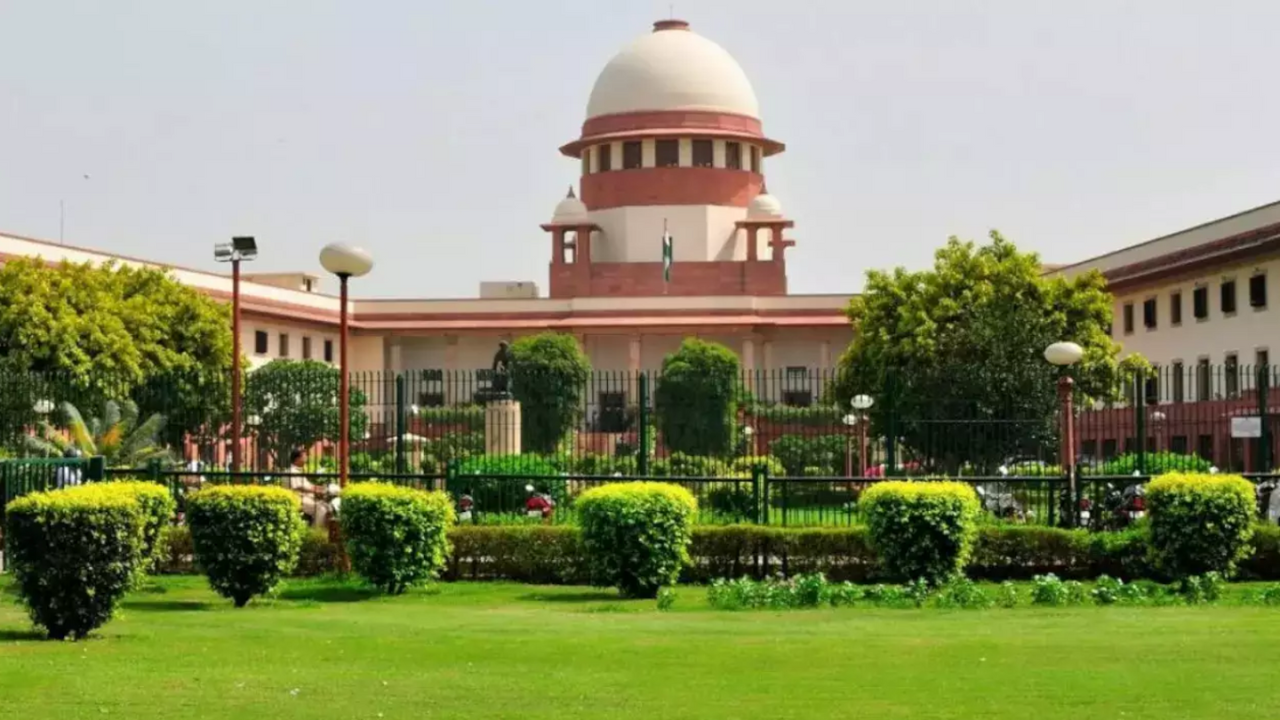
NEW DELHI: The Supreme Court ruled on Thursday that homebuyers’ societies, or Resident Welfare Associations (RWAs), generally established for the maintenance and management of common facilities in housing projects, do not possess the right to intervene in the insolvency proceedings of the developer company.
A bench comprising Justices JB Pardiwala and R Mahadevan upheld the insolvency proceedings against Takshashila Heights India Private Ltd under the Insolvency and Bankruptcy Code of 2016. It specified that if creditors aim to utilize the provisions of the code, they must genuinely seek to revive the corporate debtor.
The court stated, “If revival is not the goal, the Code cannot be used as a means for convenient recovery; alternative statutory remedies, such as those under SARFAESI or other applicable laws, are still valid.”
The bench supported the National Company Law Appellate Tribunal’s (NCLAT) rejection of an intervention application from Elegna Co-operative Housing and Commercial Society Ltd, asserting it lacked the standing to participate in the company’s appeal.
The bench reiterated that the IBC is a self-contained statute granting participatory rights solely to entities defined by law, whereby a financial creditor, per Section 5(7), must be an individual to whom a financial debt is owed.
“While the explanation to Section 5(8)(f) considers individual allottees as financial creditors, this status does not extend to societies or associations unless the entity is a creditor in its own right or recognized as an authorized representative under the Code,” it stated.
The bench further elaborated that a society is a separate legal entity distinct from its members, and unless it has provided funds, executed allotment agreements, or received allotments, it cannot claim the status of a financial creditor.
“The right to initiate or participate in Corporate Insolvency Resolution Process (CIRP) derives from the debt transaction and the statute, not from associative interest,” it explained, concluding that a society or RWA, lacking creditor status and not being recognized as an authorized representative under the IBC, cannot intervene in proceedings stemming from a Section 7 petition.
Justice Mahadevan, delivering the judgment on behalf of the bench, noted that homebuyers’ societies or welfare associations are generally formed for managing common facilities.
“Their office-bearers cannot litigate on behalf of allottees or claim representative status in legal proceedings without explicit statutory recognition or valid authorization,” the court observed.
It added that any opposing interpretation would unjustly broaden the definition of “financial creditor,” infringe on the individual rights of allottees, and create an extrastatutory layer of representation.
“This could likewise allow errant corporate debtors to delay and obstruct insolvency proceedings under the pretext of collective interests — a misuse specifically warned against in the Pioneer Urban Land (2019 ruling),” it remarked.
The bench also clarified that Section 7 proceedings of the IBC are essentially bipartite at the admission stage, involving only the financial creditor and the corporate debtor.
“Unrelated third parties, including other creditors, possess no independent rights to participate at this stage, a principle consistently upheld by this Court,” it stated, indicating that collective representation of homebuyers is statutorily regulated and only arises after the admission of CIRP through authorized representatives.
The bench emphasized that the IBC does not allow for ad hoc or self-appointed representation at the pre-admission or appellate stage. Regarding real estate allottees, Section 7 specifically mandates that applications must be jointly filed by the requisite number of allottees, not through any authorized representative, let alone a non-party housing society created for maintenance.
In the present case, the bench concluded that the Elegna Co-operative Housing and Commercial Society is neither a financial nor an operational creditor but merely a maintenance society not intended for insolvency representation.
“The Society is not a party to the financial transactions underlying the Section 7 application, hence it lacks any statutory right to appeal,” the court stated, asserting that the NCLAT’s ruling on the absence of locus standi is legally sound.
“Allowing such intervention would undermine the efficient and structured insolvency framework established by the Code,” it said, reiterating that the Court has consistently worked to protect the rights of homebuyers navigating challenges in India’s real estate sector.
It affirmed its commitment to ensuring the legitimate interests of homebuyers within legal confines.
“The preferred approach is to engage constructively with the Committee of Creditors to complete the project and promote the collective good, rather than fragmenting the process through individual interests,” it concluded.