
BENGALURU: North Bengaluru is transitioning from a potential market to a thriving residential hub, fueled by airport accessibility, infrastructure growth, social facilities, and an increase in office demand, industry experts noted on Tuesday.
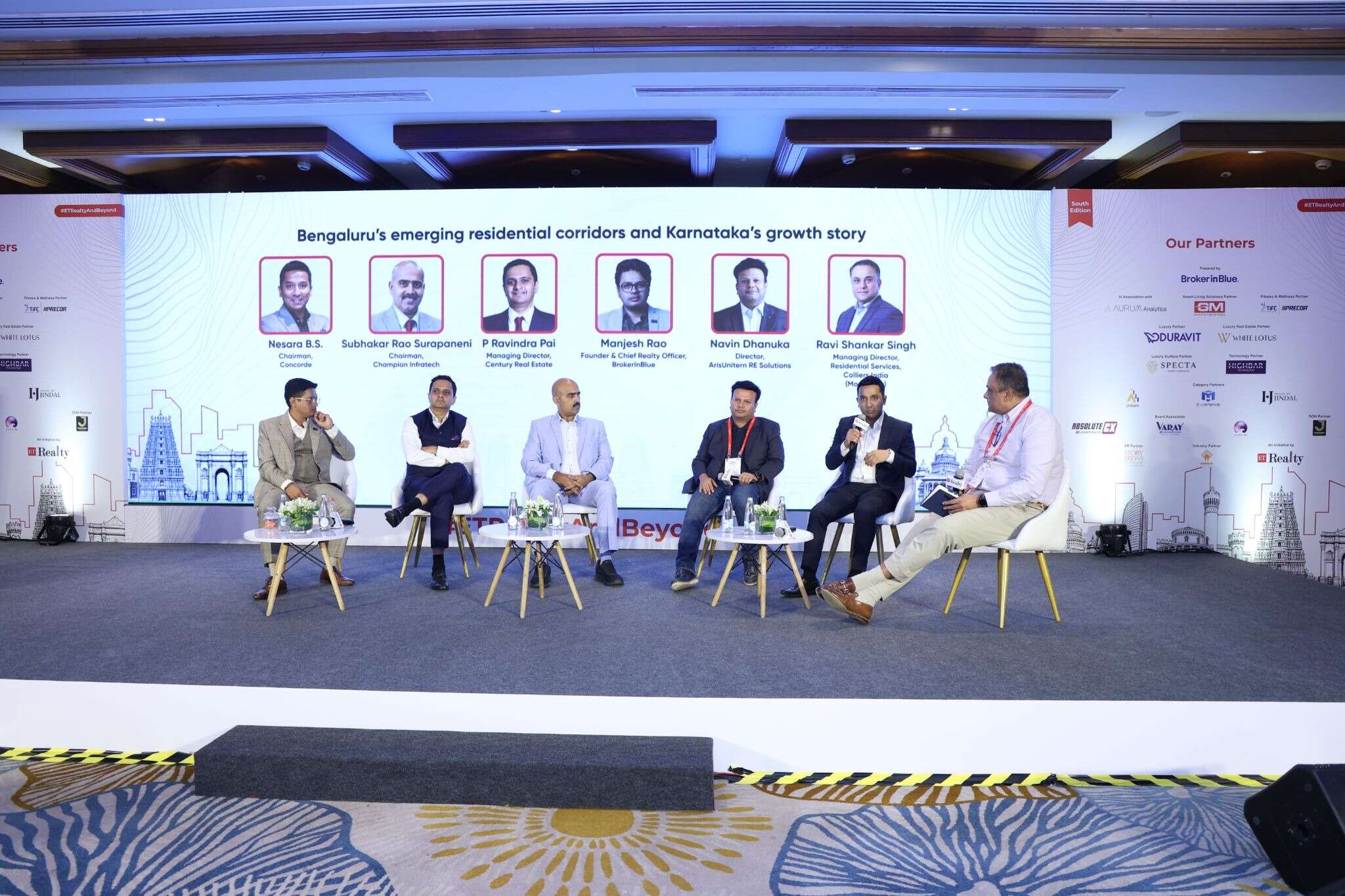
These insights emerged during the RealtyDailyNews Realty & Beyond Summit in Bengaluru, where a panel discussion focused on the city’s evolving residential sectors and Karnataka’s growth trajectory.
The discussion featured industry leaders including Nesara B.S., Chairman of Concorde; Subhakar Rao Surapaneni, Chairman of Champion Infratech; P Ravindra Pai, Managing Director of Century Real Estate; Manjesh Rao, Founder & Chief Realty Officer of BrokerInBlue; and Navin Dhanuka, Director of ArisUnitern RE Solutions. Ravi Shankar Singh, Managing Director of Residential Services at Colliers India, served as the moderator.
Pai emphasized that the growth in North Bengaluru has been in progress for years, bolstered by the airport and expressway connectivity, upcoming metro lines, and large land availability.
“The city is gravitating towards the airport,” he stated, noting the region’s advantages in terms of robust infrastructure, green spaces, and government emphasis on connectivity projects.
He declared that the region has now surpassed mere long-term potential.
“We are in the moment of North Bengaluru,” he said.
Surapaneni suggested that the next wave of residential development will extend beyond location-focused projects and amenity-rich housing. He believes buyers will seek integrated communities centered on convenience, wellness, and mobility.
“The next evolution will be 15-minute cities,” he remarked, adding that residents should be able to walk or cycle to work and have easy access to recreational spaces within their communities.
He also pointed out that Bengaluru’s water issues could be addressed through improved rainwater harvesting, lake rejuvenation, and aquifer replenishment.
“Bangalore has plenty of water; we just need to manage runoff better,” he stated.
Rao highlighted that while there is robust buyer interest in Bengaluru, escalating prices are making the actual investment size crucial. He observed that property prices in North Bengaluru have surged over the past five years, with significant interest in plotted developments and villas.
“The investment size will be more pivotal than the price itself,” he added.
He noted a growing interest from NRIs looking to purchase homes in Bengaluru, either for future returns or as a secure asset.
Dhanuka commented that North Bengaluru is nearing the residential supply levels of East Bengaluru. He indicated that office tenants are increasingly considering North Bengaluru due to its improving infrastructure and competitive prices in more established areas.
“The airport road is set to become the new ORR, and the Park Road Industrial Area is on track to be the next Whitefield,” he noted.
In regard to integrated townships, Pai mentioned that land aggregation continues to be the main hurdle for developers. He explained that assembling large land parcels involves complexities related to legal issues, zoning, revenue, and conversion, making township developments a lengthy process.
“Acquiring substantial tracts of land poses a significant challenge,” he said, emphasizing that private developers along with land aggregators will remain vital players in this space.
The panel also explored the potential of Karnataka’s satellite cities to alleviate pressure on Bengaluru. While Pai expressed skepticism about replicating Bengaluru’s decades-long talent and infrastructure advantages, he and his colleagues identified Mysuru as having potential if supported by enhanced airport connectivity, job creation, and government incentives.
Rao pointed out that Mysuru possesses the foundational elements needed to evolve into a strong growth center but requires more strategic economic planning.
“Attracting the right tenants while providing tailored incentives will be essential,” he argued.
Manjesh Rao observed significant shifts in buyer preferences, especially among global Indians and senior executives. He noted that buyers now prioritize lifestyle, educational facilities, sports infrastructure, and the broader community ecosystem over mere square footage.
“People no longer remember the size of their homes; it’s about their experience living there,” he emphasized.
The overarching message from the panel was that Bengaluru’s next residential phase will rely significantly on effectively integrating infrastructure, employment, social amenities, and overall livability. While North Bengaluru is currently leading the market, developers believe that future demand will increasingly follow areas that provide connectivity, quality of life, and cohesive urban planning.