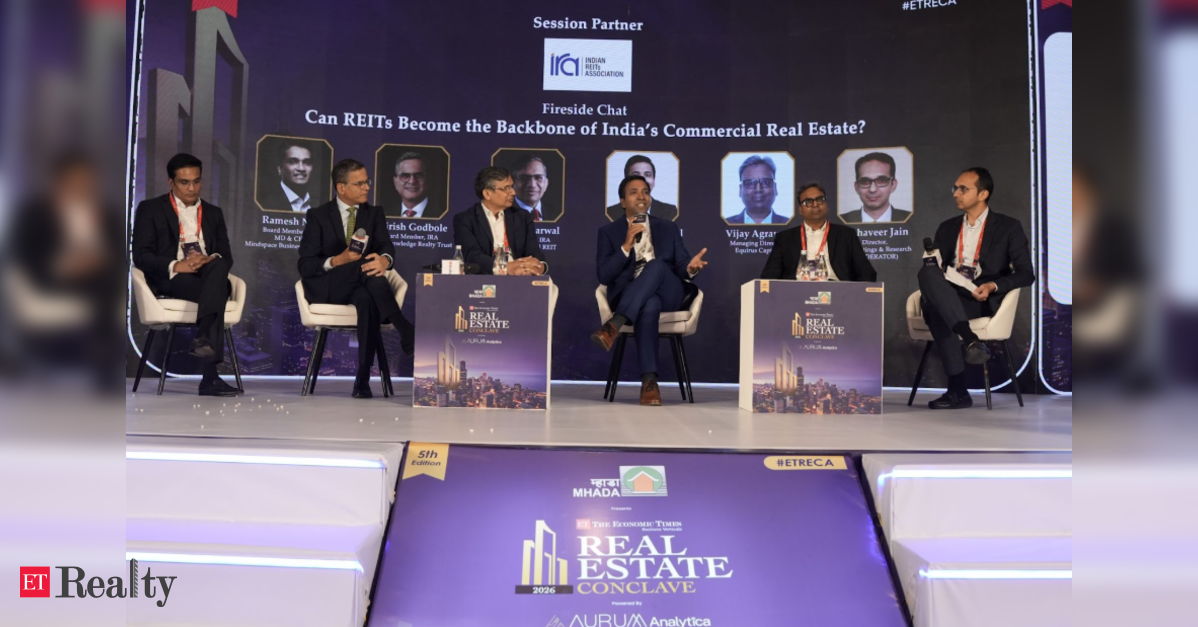

The discussion emphasized the considerable opportunities within India’s commercial stock.
REITs are transitioning from a niche market to a mainstream option as capital markets broaden their involvement in India’s commercial real estate sector. This was a key takeaway from a conclave session discussing the potential of REITs as the backbone of the industry.
Moderated by Mahaveer Jain, Director at India Ratings & Research, the panel included Ramesh Nair (Board Member, IRA | MD & CEO, Mindspace Business Parks REIT), Shirish Godbole (Board Member, IRA | CEO, Knowledge Realty Trust), Alok Aggarwal (Chairperson, IRA | CEO, Brookfield REIT), Abhishek Agarwal (CFO, Embassy REIT), and Vijay Agrawal (Managing Director, Equirus Capital).
On the topic of investor return expectations, panelists portrayed REITs as a long-term investment strategy that combines consistent distributions with asset appreciation. One speaker noted, “Over the long term, you can anticipate a yield of six to eight percent alongside another six to eight percent in capital appreciation.” The panel urged caution against short-term market fluctuations, asserting that REITs should be evaluated over a decade-long timeframe, where rental contracts, occupancy stability, and distribution consistency are crucial measures of performance.
Alok Aggarwal emphasized the extensive opportunities available in India’s commercial stock, highlighting the significant potential for upgrades and reassignments. While India has reached around a billion square feet of office space, only a small portion is institutionally leased and qualifies as “REIT-grade,” indicating opportunities for retrofitting, repositioning, and integrating higher-quality assets into the public market. Beyond office spaces, the speakers noted a growing supply of REIT-compatible assets like hospitals and data centers—market segments that, while not as sizable as office space, could expand the investment landscape over time.
Abhishek Agarwal pointed out that understanding of REITs is rapidly increasing among investors, spurred by a surge in domestic capital inflows over the past 18 months. However, he mentioned significant educational gaps outside major metropolitan areas and key capital market centers. “Indians love owning real estate,” he stated, but also pointed out the barriers associated with direct ownership—such as illiquidity and management burdens—positioning REIT units as a more accessible alternative offering both income distributions and price growth. He noted that the broadening shareholder base of Embassy REIT highlights its early mainstream acceptance, though deeper penetration will require ongoing awareness efforts.
Ramesh Nair noted that GCCs serve as a long-term catalyst for office space absorption while recognizing the need to prepare for potential disruptions caused by AI. Nevertheless, the panel agreed that occupiers would continue to gravitate towards well-situated, professionally managed, ESG-aligned properties, bolstering high-quality office portfolios. This shift towards quality reinforces the rationale for expanding REIT-grade inventory, even as lower-quality properties may face challenges.
With upcoming IPOs, SM-REIT frameworks, and more asset categories coming into play, the message from the panel was clear: India is still in the early stages of its REIT journey. For the sector to establish itself as a true cornerstone of commercial real estate, it will require enhanced valuation practices, consistent governance, transparent investor communication, and a stronger pipeline of assets capable of maintaining predictable distributions through various economic cycles.