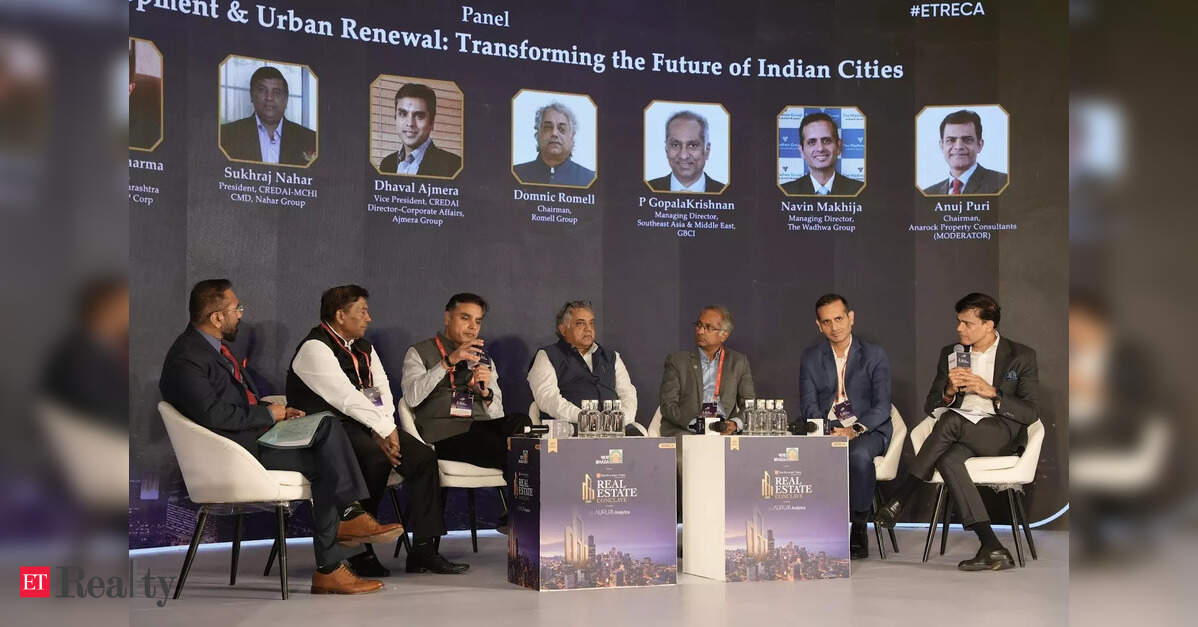
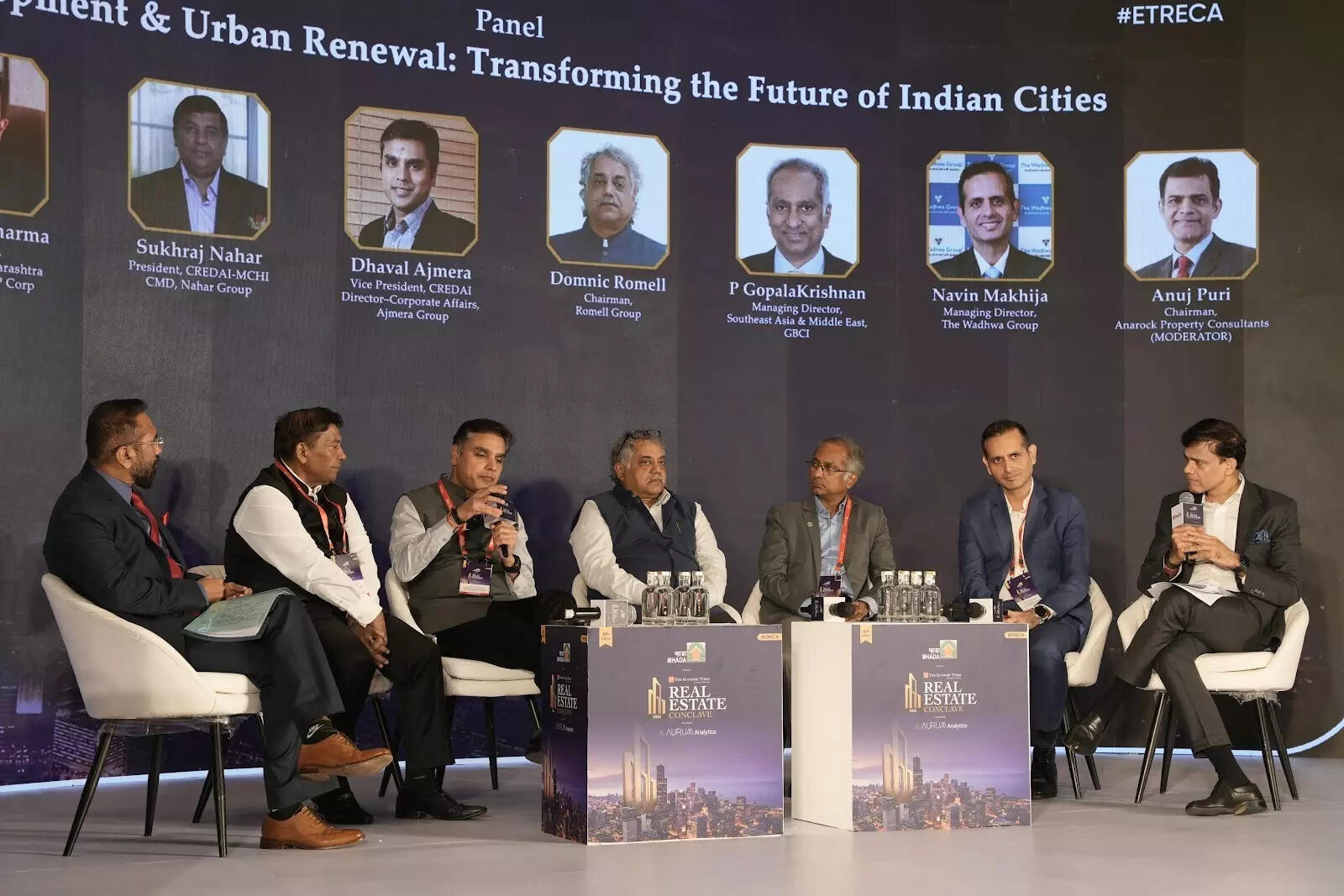
At the RealtyDailyNews Realty Real Estate Conclave 2026, industry leaders and policymakers came together for a panel titled ‘Redevelopment & Urban Renewal: Transforming the Future of Indian Cities’. This discussion emphasized the necessity of brownfield redevelopment in space-constrained cities like Mumbai.
Moderated by Anuj Puri, Chairman of Anarock Property Consultants, the panel included notable figures such as Anil Wankhede (Deputy CEO, MHADA), Prashant Sharma (President, NAREDCO Maharashtra and Chairman, GHP Corp), Sukhraj Nahar (President, CREDAI-MCHI and CMD, Nahar Group), Dhaval Ajmera (Vice President, CREDAI and Director–Corporate Affairs, Ajmera Group), Domnic Romell (Chairman, Romell Group), P GopalaKrishnan (Managing Director, Southeast Asia & Middle East, GBCI), and Navin Makhija (Managing Director, The Wadhwa Group).
Wankhede initiated the discussion by stressing the significance of social inclusivity in redevelopment, noting that MHADA aims to ensure that housing access is not solely profit-driven. He explained that redevelopment initiatives will create housing stock priced at construction costs.
“We base pricing only on construction costs,” he stated, predicting the creation of nearly 20,000 units through these efforts, thereby promoting subsidized housing supply within private redevelopment frameworks.
On the topic of financing, Prashant Sharma pointed out that institutional capital is increasingly looking at cluster-level redevelopment. “Among the three primary land sources — MHADA, SRA, and societies — society redevelopment is often regarded as the safest,” he remarked, noting that larger cluster projects attract invested capital due to their scale, planning clarity, and reduced competitive fragmentation. However, he cautioned that investors are still wary of smaller, independent society projects.
Trust and governance emerged as critical themes. Sukhraj Nahar pointed to internal conflicts within societies and credibility issues as significant obstacles. “Redevelopment is like a marriage,” he noted, emphasizing that while financial viability might account for 60% of a decision, trust between the society and the developer is crucial for long-term success. Developers highlighted the importance of reputation, delivery history, and transparent communication in minimizing execution risks.
Infusing a sustainability perspective, P GopalaKrishnan argued that green compliance should progress beyond a mere formality. “It must be outcome-oriented, not just a checklist,” he insisted, advocating for measurable environmental outcomes in cluster master plans.
With redevelopment largely occurring in densely populated brownfield areas in Mumbai, it is vital to integrate climate resilience, energy efficiency, and community planning to maintain the urban ecosystem’s health.
Navin Makhija reinforced that redevelopment needs to go beyond simple financial metrics. Evaluating location strength, product-market fit, and genuine demand is crucial before making large acquisitions. The panel broadly concurred that predictable regulations, quicker approvals, and structured financing models — such as blended finance and rental housing frameworks — are essential for reducing project risks.
As Indian metros exhaust greenfield opportunities, the conclave’s message was clear: Cluster-driven, governance-supported, and sustainability-focused redevelopment is the only sustainable path for equitable and future-ready urban development.