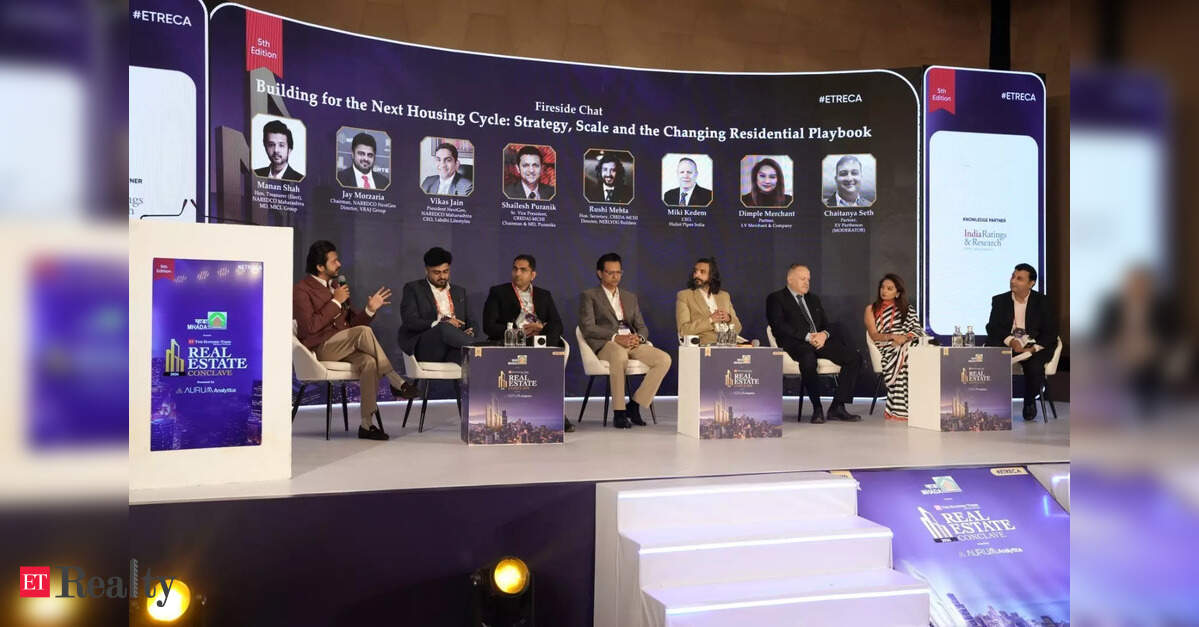

At the RealtyDailyNews Realty Real Estate Conclave 2026, a high-profile fireside chat titled ‘Building for the Next Housing Cycle: Strategy, Scale and the Changing Residential Playbook’ convened key figures from the residential sector to discuss future trends.
Moderated by Chaitanya Seth, Partner at EY Parthenon, the panel included Manan Shah, Treasurer (Elect) of NAREDCO Maharashtra and MD of MICL Group; Jay Morzaria, Chairman of NAREDCO NextGen and Director of VRAJ Group; Vikas Jain, President NextGen of NAREDCO Maharashtra and CEO of Labdhi Lifestyles; Shailesh Puranik, Vice-President of CREDAI-MCHI and CMD of Puraniks; Rushi Mehta, Hon. Secretary of CREDAI-MCHI and Director of Neelyog Builders; Miki Kedem, CEO of Huliot Pipes India; and Dimple Merchant, Partner at I V Merchant & Company.
Seth set the stage by reviewing the market’s volatility over the past decade—covering the stagnant cycle from 2016 to 2020, followed by a rapid rebound post-pandemic from 2021 to 2025, driven by policy reforms, GST-enabled transparency, capital market involvement, and increased institutional oversight. He raised the essential question of which transformations are structural versus cyclical as the market matures.
Manan Shah highlighted infrastructure as the primary long-term demand driver, particularly in Mumbai and the MMR region. “Real estate is being recognized as an industry,” he stated, emphasizing the impact of regulatory reforms and professionalization. He cited that major infrastructure projects, such as metro corridors and coastal connectivity, are altering buyer behavior and expanding viable residential areas. However, he stressed concerns over pricing pressures: “Prices are bound to rise over the next five years, as developers have no other option,” citing increased land acquisition costs, redevelopment premiums, and inflation in labor and materials.
Jay Morzaria added to the discussion, emphasizing infrastructure’s structural influence on residential strategies. “The map of Mumbai has transformed significantly,” he noted, observing that better connectivity is diminishing the traditional north-south divide and fostering multiple sub-markets within the city. He asserted that Mumbai can no longer be treated as a uniform residential market; instead, micro-market dynamics—dictated by commute times, affordability, and product positioning—will increasingly dictate success.
The panel also explored shifting customer preferences, particularly among younger, well-traveled buyers who seek superior design, amenities, sustainability, and community-oriented living. Developers agreed that maintaining disciplined growth—balancing expansion goals with financial prudence—is crucial in a high-cost environment. Adherence to governance standards, compliance rigor, and technology adoption have become imperative, as lenders and private equity investors demand transparency and reliable execution.
Looking to the future, the unanimous sentiment was that the next housing cycle will hinge less on speculative momentum and more on structural fundamentals: infrastructure-driven growth, micro-market differentiation, capital discipline, and customer trust. Developers who align their product strategies with long-term urban transformations, rather than short-term price fluctuations, are expected to navigate the next phase of residential growth successfully.