NEW DELHI: Nearly 50 years after the New Okhla Industrial Development Authority (Noida) was established, the Supreme Court urged the Uttar Pradesh government to contemplate the establishment of a metropolitan council aimed at enhancing citizen-centric governance.
This directive stemmed from the findings of a Supreme Court-appointed Special Investigation Team (SIT), which presented a critical report about Noida Authority, identifying that decision-making is overly centralized among a limited number of officials.
A bench composed of Justices Surya Kant and Joymalya Bagchi endorsed the SIT’s recommendations, stating: “To promote transparency and fairness in the daily operations of Noida, we instruct the UP Chief Secretary to present the recommendations… before the council of ministers for an appropriate decision.”
Until that decision is reached, the bench ordered the Chief Secretary to assign a Chief Vigilance Officer—preferably an IPS officer or an officer on deputation from the CAG—to conduct a financial audit in Noida.
According to the SIT’s findings, Noida officials were involved in 20 cases of overpayment in compensation to landowners. Led by IPS officer SB Shiradkar, the SIT concluded that Noida’s land allotment policies favor developers and highlighted a significant absence of transparency and fairness in the authority’s overall operations.
Form a citizen advisory board for Noida in four weeks: SC to UP government
The court also called for an examination of the assets of officials and their relatives to ascertain who benefited from the excessive compensation paid by Noida.
The SIT noted that the discretionary power wielded by Noida officials in land allotments could soon eliminate available land for future development in Delhi’s neighboring city. It also pointed out the lack of systematic public engagement and environmental impact assessments for projects in Noida. Residents frequently express concerns about delays and inadequate resolution of grievances, as Noida Authority tends to respond reactively instead of proactively.
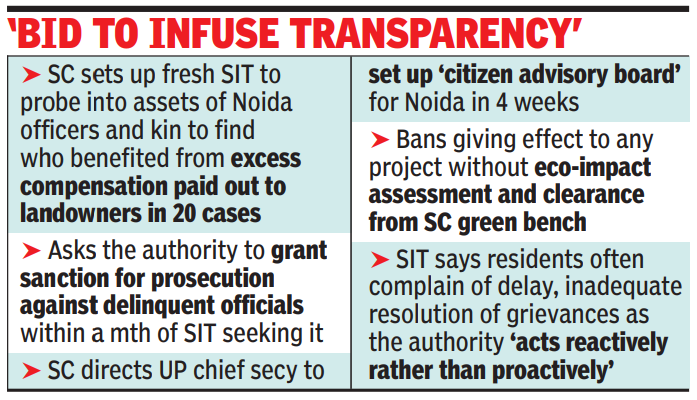
The Justice Kant-led bench directed the Chief Secretary to establish a citizen advisory board for Noida within four weeks and prohibited the initiation of any projects in Noida without conducting environmental impact assessments and obtaining clearance from the Supreme Court’s green bench.
In the 20 instances of excess compensation paid to landowners, linked to alleged collusion among Noida officials identified by the SIT, the bench created another SIT to investigate these officials and file FIRs if a cognizable offense is detected. It instructed the authority to grant prosecution sanctions for culpable officials within four weeks following the SIT’s request.
“The SIT, led by a police officer not lower than the rank of Commissioner, will register preliminary inquiries and investigate the highlighted issues from the previous SIT report, involving specialists from forensic accounting and the economic offenses wing. Should the SIT discover a cognizable offense after preliminary inquiry, FIRs will be filed,” the bench declared.
The court requested a status report on the investigation from the SIT but clarified that the excess compensation payments to landowners would not be reclaimed.