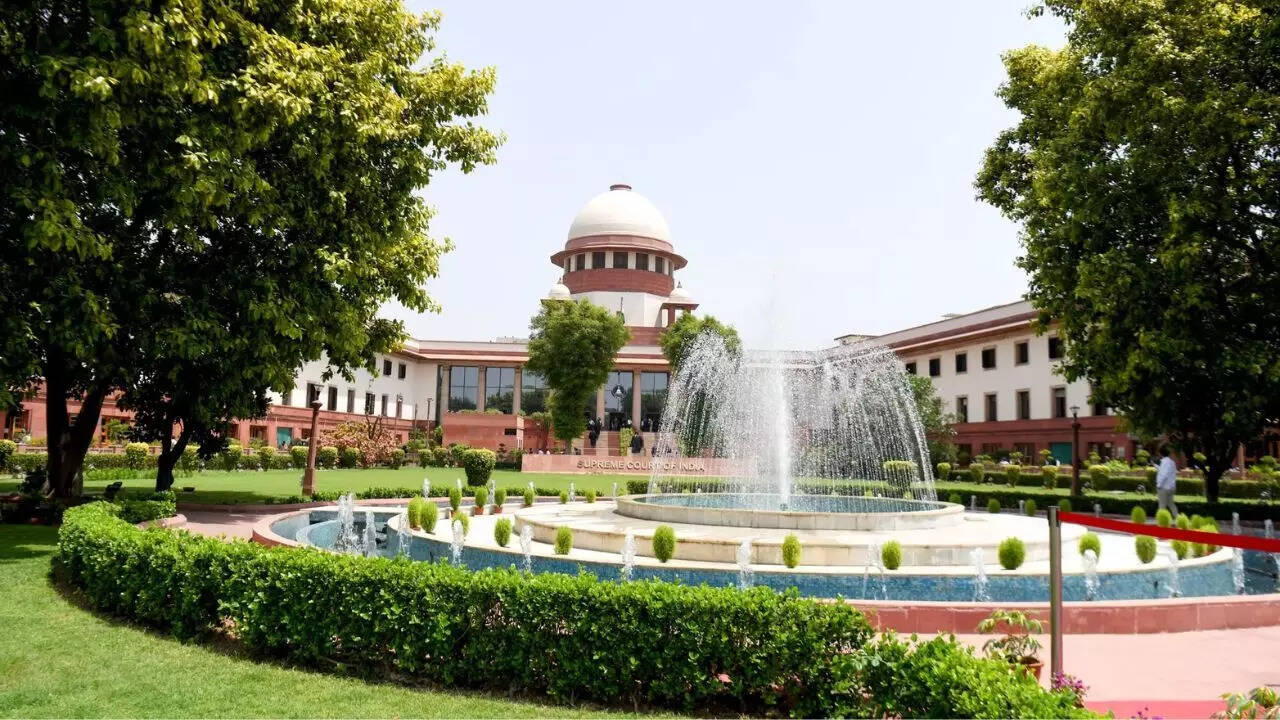
MUMBAI: Recently, the Supreme Court upheld an interim order from the Bombay High Court, which denied a request to stay the termination of a lease for 150 acres of salt pan land from a total of 782 acres located in Mulund, Bhandup, and Kanjurmarg. The court emphasized that a stay is not a statutory entitlement in appeals.
The Supreme Court expressed a “prima facie opinion,” indicating that the High Court correctly denied relief to the lessee based on equitable considerations, as the specified 150 acres adjacent to the Eastern Express Highway had not been used for salt production for nearly 30 years.
The lessee, Vikas Walawalkar, has not utilized the land for its intended purpose since at least 1995, according to the High Court. The Supreme Court noted that the High Court “rightly acknowledged” the lack of use of the 150 acres for salt production, asserting that allowing the lease to persist would be unjust to the Center.
The vast 782-acre area—equivalent to 90% of Central Park in New York City—has been leased by the Salt Commissioner since 1917 for a 99-year term. The lease was transferred to Walawalkar in 1994, but was terminated by the Center in 2004 due to improper use and insufficient salt production, with grass overtaking the land.
Walawalkar challenged the termination in the High Court in 2005. In May 2023, Justice S V Marne of a single Judge High Court bench dismissed his suit and upheld the lease termination for all 782 acres, stating that land in Mumbai, the country’s commercial hub, cannot create vested rights for salt manufacturing.
The High Court ruled that salt pan lands owned by the Center are exclusively for salt production. This case involved two salt works: ‘Battiwala Salt Works’ and ‘Jamasp Salt Works’ located in Mumbai’s Mulund, Bhandup, and Nahur areas.
Walawalkar escalated the matter to a two-Judge appeal bench of the High Court and requested a temporary stay on the termination. In August, the High Court initially granted a stay but in April 2025, the division bench of Justices B P Colabawalla and F P Pooniwalla partially lifted the stay on the 150 acres, citing the absence of salt manufacturing. However, the Court protected the remaining 632 acres, preventing Walawalkar’s dispossession as long as he continues to pay ground rent and assignment fees.
During the Supreme Court proceedings, senior counsel Gopal Shankaranayanan argued that the High Court shouldn’t have vacated the stay on the 150 acres, as reversing its decision later would be unfeasible if Walawalkar ultimately succeeds in his appeal against the lease termination.
For the Center, Solicitor General Tushar Mehta defended the High Court’s order, stating that even Walawalkar admitted that the land had been unused since at least 1995.
The Supreme Court refrained from commenting on the merits of the case, indicating that the High Court is better equipped to assess the factual issues, noting that any premature observations might prejudice the parties’ rights in the ongoing appeal.