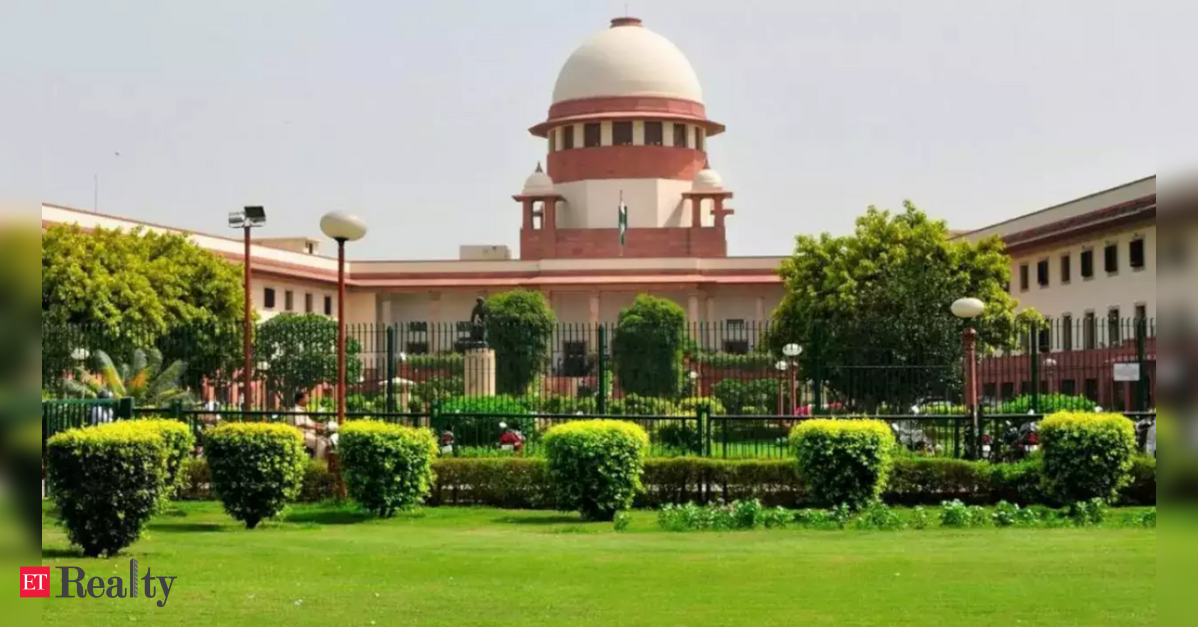
NEW DELHI: The Supreme Court announced on Wednesday that the Special Investigation Team (SIT) it formed to investigate inflated compensation payments to farmers—allegedly involving collusion among NOIDA officials—must also look into the actions of chief executive officers and others leading the authority for the past 10-15 years.
A bench consisting of Chief Justice Surya Kant, Justice Ujjal Bhuyan, and Justice N Kotiswar Singh has extended the SIT’s investigation period by an additional two months.
Solicitor General Tushar Mehta, representing NOIDA, expressed his intention to submit an affidavit outlining the authority’s stance on the matter.
The court clarified that farmers receiving higher payments will not face penalties, and no coercive actions will be taken against them.
Senior advocate Siddharth Dave, representing a farmer who allegedly received inflated compensation, stated he has been receiving notifications from the SIT to provide his statement.
“Please ensure the protection of farmers, as they are not to blame,” he urged the bench.
The bench reiterated that the investigation’s purpose is not to harass farmers but to examine the roles of officials involved in the questionable compensation payments.
It acknowledged the status report submitted by the SIT, which requested three more months to finalize the investigation.
On August 13, the Supreme Court ordered an SIT probe into NOIDA officials for allegedly conspiring with builders to provide landowners with compensation exceeding their entitlement.
The Court accepted the SIT’s initial findings, which revealed prima facie validity in the allegations, and directed that the SIT’s recommendations, led by senior IPS officer S B Shiradkar, be presented to the Uttar Pradesh chief secretary. The chief secretary was tasked with presenting the findings to the council of ministers for potential conversion of Noida into a “metropolitan council.”
In light of the SIT’s findings, the Court established another SIT comprising three senior IPS officers to review the bank accounts and assets of errant NOIDA officials and other related beneficiaries, with support from forensic auditors and economic offense specialists.
“The DGP of UP shall form an SIT with three police officers from the IPS cadre to investigate the issues identified by the previous SIT,” the Court stated.
On January 23, the top court laid out four areas for the SIT to investigate: whether compensation payments exceeded entitlements, who was responsible for such payments, whether there was collusion between beneficiaries and NOIDA officials, and if NOIDA’s overall operations lacked transparency, fairness, and commitment to public interest.
The Court instructed the new SIT to initiate preliminary inquiries and investigate the previously highlighted points regarding the potential collusion between beneficiaries and NOIDA officials.
“If the SIT finds evidence of a prima facie cognizable offense during its preliminary investigation, it shall register a case and proceed with legal steps,” the Court emphasized.
To enhance transparency in the investigation, the Court required the chief secretary to appoint a chief vigilance officer, preferably from the IPS cadre, or on deputation from the Comptroller and Auditor General (CAG), within four weeks.
Additionally, the state government was instructed to establish a citizen advisory board in Noida immediately.
“Likewise, the chief secretary should present the matter to the competent authority to ensure the formation of the citizen advisory board within four weeks,” the court directed.
The Court mandated that the findings of the new SIT should be documented as a status report by its head, who must be an officer of no less than police commissioner rank.
Furthermore, the Court ordered that no projects be initiated in Noida without an environmental impact assessment and approval from the green bench of the Supreme Court.
To expedite investigations against delinquent officials, the Court insisted that any required prior approval for prosecution under the Prevention of Corruption Act should be granted by the competent authority within two weeks.
On January 23, dissatisfied with the investigative panel appointed by the UP government, which was examining illegal compensation payments to landowners made by NOIDA officials, the Supreme Court appointed an SIT to conduct the inquiry.
This decision arose while considering anticipatory bail pleas from the legal advisor and a law officer of the NOIDA authority, who faced corruption accusations related to inappropriate compensation payouts to landowners.