
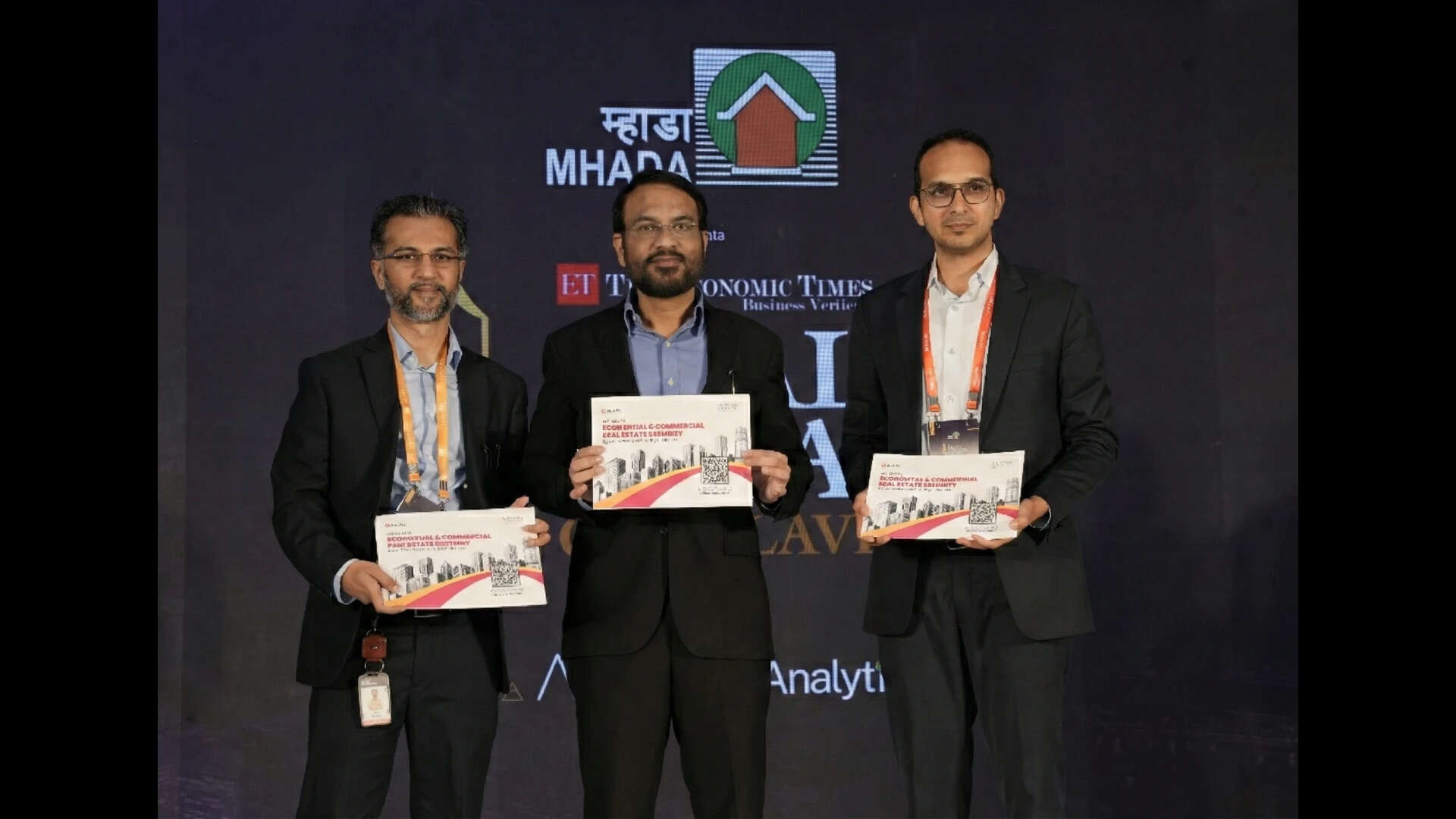
NEW DELHI: The residential real estate market in India is set to experience a slowdown in growth in FY27, following a strong rebound post-pandemic. Sales are projected to increase by 5-7% year-on-year, predominantly driven by value growth in the premium and mid-market segments, as per a whitepaper released by India Ratings & Research (Ind-Ra) in collaboration with ETRealty at ETRECA 2026 on February 25 in Mumbai.
After a significant expansion during FY23-FY25 and a steadier FY26, the sector is entering a consolidation phase, with high price levels and a strong base effect anticipated to dampen growth rates. Ind-Ra predicts total sales to reach approximately 641 million sq ft in FY26, compared to 622 million sq ft in FY25, with an 8% year-on-year growth reported in the last 12 months ending September 2025 across the top eight real estate clusters.
Premium Segment Boosts Absorption; IT Hiring Slowdown a Concern
The growth following the pandemic has primarily been fueled by premium and luxury housing, shifting supply preferences toward the upper mid-income and high-ticket segments. Ind-Ra forecasts that long-term sales growth will align with gross fixed capital formation growth of 9-10% annually in value terms, particularly in the ₹1-3 crore (mid-market) and ₹3-7 crore (premium) segments.
Nevertheless, the agency emphasizes a near-term risk posed by slower net headcount increases among large IT service firms and consolidation due to AI and automation, potentially reducing upgrade demand in IT-driven markets like Bengaluru, Pune, and Hyderabad.
While domestic demand remains positive in volume (sq ft), unit growth has slowed despite lower interest rates. Favorable demographics, the aspiration for larger homes, rising disposable incomes among dual-income households, and investment interest from NRIs and high-net-worth individuals sustain this demand.
Mixed Regional Trends; MMR Leads the Market
The Mumbai Metropolitan Region (MMR) continues to be the largest micro-market, comprising 26% of sales among the top eight clusters, followed by Hyderabad at 17%.
In the first half of FY26, Bengaluru, Ahmedabad, and MMR exhibited the strongest sales growth of 15-17% year-on-year, closely followed by NCR. Meanwhile, Pune, Chennai, and Hyderabad experienced flat to modest growth. Between FY20-FY25, Hyderabad, Pune, and MMR reported a sales CAGR surpassing 17%, whereas Bengaluru, NCR, Chennai, Ahmedabad, and Kolkata lagged the five-year average but may witness improved growth in FY27.
Ind-Ra observes that tech-centric corridors could experience elongated decision cycles in FY27 due to a slowdown in IT hiring, yet end-user intent remains robust. The mid-market segment is likely to show relative resilience.
Price Growth to Stabilize; Special Schemes Expected in Specific Markets
Aggregate housing prices in the top eight metros have risen at a post-pandemic CAGR of roughly 9%, with a 12% increase noted as of September 2025. Ind-Ra anticipates price growth to decelerate to 4-8% year-on-year in FY26 and FY27, remaining project-specific.
Tight supply, partly due to approval and environmental challenges, has enabled developers to maintain pricing discipline. However, demand moderation and elevated price levels are likely to restrict further steep increases.
NCR and Bengaluru have witnessed significant price escalation, expected to stabilize but remain above 10%. Conversely, Chennai, Kolkata, and Hyderabad, which lagged in FY25, are experiencing a recovery in FY26.
The agency warns that NCR might see time corrections or selective price cuts, especially if the previous year’s sales were driven more by investors than end-users. In Bengaluru and Pune, a softer IT hiring climate and selective fresher onboarding may lead to project-specific pricing models and increased use of subvention or flexible pay schemes to maintain sales momentum.
Improved Launch Momentum Expected in FY27
New project launches slowed in FY25 and FY26 due to a high reference base and approval-related delays, with supply in the top eight cities projected to decrease by approximately 12% year-on-year in area terms during YTDFY26.
However, Ind-Ra expects launch momentum to pick up for the remainder of FY26 and into FY27, aided by the resolution of certain regulatory obstacles and business development initiatives undertaken in FY24 and FY25.
Chennai demonstrated the highest growth in new launches at 59% year-on-year, followed by Kolkata (21%) and Bengaluru (14%). Supply has dropped in Hyderabad (down 29%), MMR (down 18%), and Pune (down 12%).
Developers are focusing on upper mid-income, premium, and luxury segments to counter rising land costs and protect margins. Unsold inventory in premium and luxury categories increased by 33% and 21% year-on-year, respectively, while the affordable segment saw an 11% decrease in unsold inventory.
Gradual Build-up of Inventory Risks
Unsold inventory was around one billion sq ft by the end of September 2025, with ready stock constituting less than 5% of the total inventory due to strong absorption during the post-pandemic revival. The quarters-to-sell (QTS) ratio remained low, at about seven quarters.
Ind-Ra anticipates that inventory levels may gradually outpace sales in FY27, with the launch-to-sales ratio likely hovering around 95%, compared to 120% shortly after the pandemic, with a long-term average of approximately 85%.
Should the market face two to three consecutive years of declining demand growth, premium and luxury inventory could see pressure. However, the demand for mid-income and upper mid-income segments is expected to remain relatively stable.
On a QTS basis, Bengaluru, Pune, and NCR are better positioned, while MMR, Ahmedabad, and Chennai face a higher inventory overhang.
Overall, while the demand for premium housing remains strong and foundational drivers such as demographics and rising incomes are intact, the residential sector appears to be transitioning into a more measured phase, with growth normalizing after a significant three-year cycle.