
As land availability tightens and competition grows in India’s major cities, strategic buyers are increasingly using the corporate insolvency resolution process under the Insolvency and Bankruptcy Code to acquire urban real estate.
This framework is becoming crucial in facilitating ownership changes and land consolidation in areas with limited supply, a trend reflected in various recent rulings by bankruptcy tribunals nationwide.
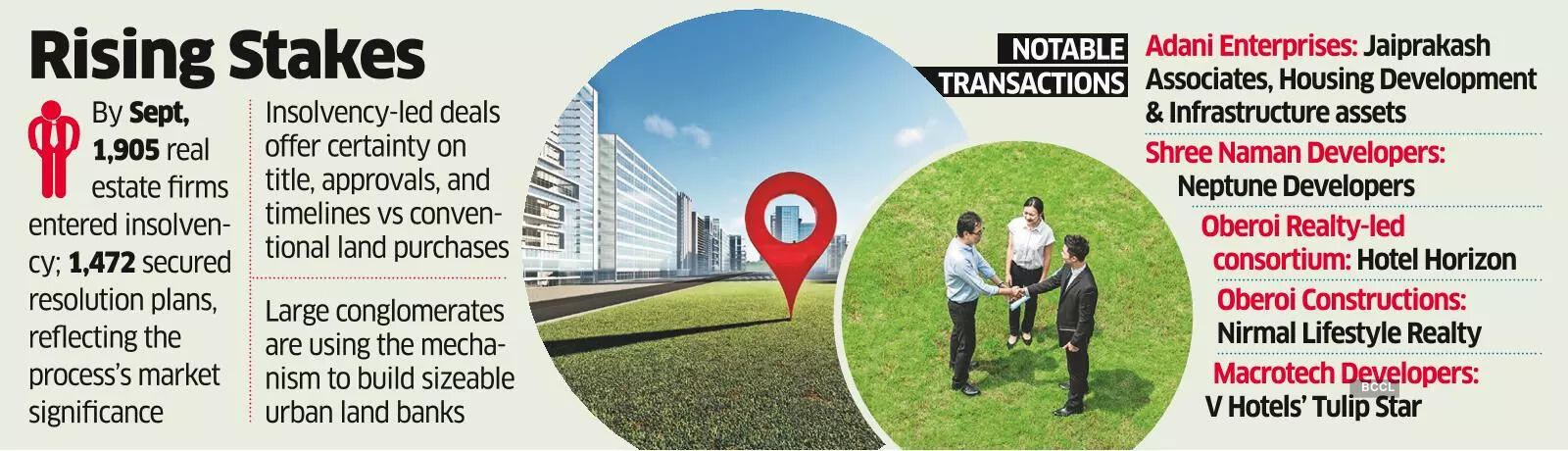
Data from the Insolvency and Bankruptcy Board of India indicates that by the end of September, 8,659 companies had entered insolvency proceedings, with around 1,905 being real estate companies. Of these, approximately 1,472 have received resolution plans from prospective buyers, showcasing the expanding impact of the bankruptcy framework on India’s real estate sector.
“For buyers assessing large urban parcels, insolvency-driven transactions provide much more certainty regarding title, approvals, and timelines compared to traditional land deals. Once a resolution plan is approved, execution risks diminish significantly, which encourages serious developers to invest large sums at this stage instead of pursuing fragmented land assemblies,” said Sanjay Daga, MD & CEO of Anex Advisory.
He noted that projects acquired through the insolvency process carry no previous or hidden liabilities, providing clear ownership.
Ajay Khatlawala, a senior partner at Little & Co, mentioned that assets with all necessary regulatory approvals in well-established areas are in high demand, particularly as the sector experiences a significant uptick in activity. Developers are drawn to such assets because the resolution process delivers “clean” ownership, free from legacy liabilities and often at appealing valuations.
Major conglomerates have also utilized the insolvency resolution process to build substantial land banks. In November, Adani Enterprises received approval from lenders to acquire Jaiprakash Associates through the resolution process with a plan valued at over ₹14,500 crore, giving access to 3,985 acres in Noida and Greater Noida, Uttar Pradesh.
In July, the group successfully acquired two assets from the insolvent Housing Development and Infrastructure Ltd, including a commercial property in Mumbai’s Bandra-Kurla Complex and a land parcel in Kalyan Shahad.
Mumbai has witnessed a consistent flow of similar transactions. In April, the tribunal approved Shree Naman Developers’ acquisition of Neptune Developers, which had liabilities of approximately ₹2,119 crore. The resolution plan proposed a payment of ₹390 crore for the company’s revival.
In August, secured lenders sanctioned a consortium led by Oberoi Realty, along with Shree Naman Developers and JM Financial Properties, to acquire Hotel Horizon, which includes a 1.85-acre land parcel in Mumbai’s prestigious Juhu area overlooking the Arabian Sea.
In August 2024, the tribunal approved Oberoi Realty affiliate Oberoi Constructions’ resolution plan for acquiring Nirmal Lifestyle Realty, laying out a thorough restructuring under the Insolvency and Bankruptcy Code, 2016.
The plan included payments of about ₹273 crore to financial, operational, and other creditors, against claims surpassing ₹748 crore. The company entered insolvency proceedings in December 2021.
Other transactions include Macrotech Developers’ acquisition of V Hotels, owner of Tulip Star (formerly known as Centaur Hotel), located on a 6.1-acre site on Juhu Tara Road in Mumbai’s Vile Parle suburbs. Meerut-based Raghupati Construction was also acquired by NASA Consortium.