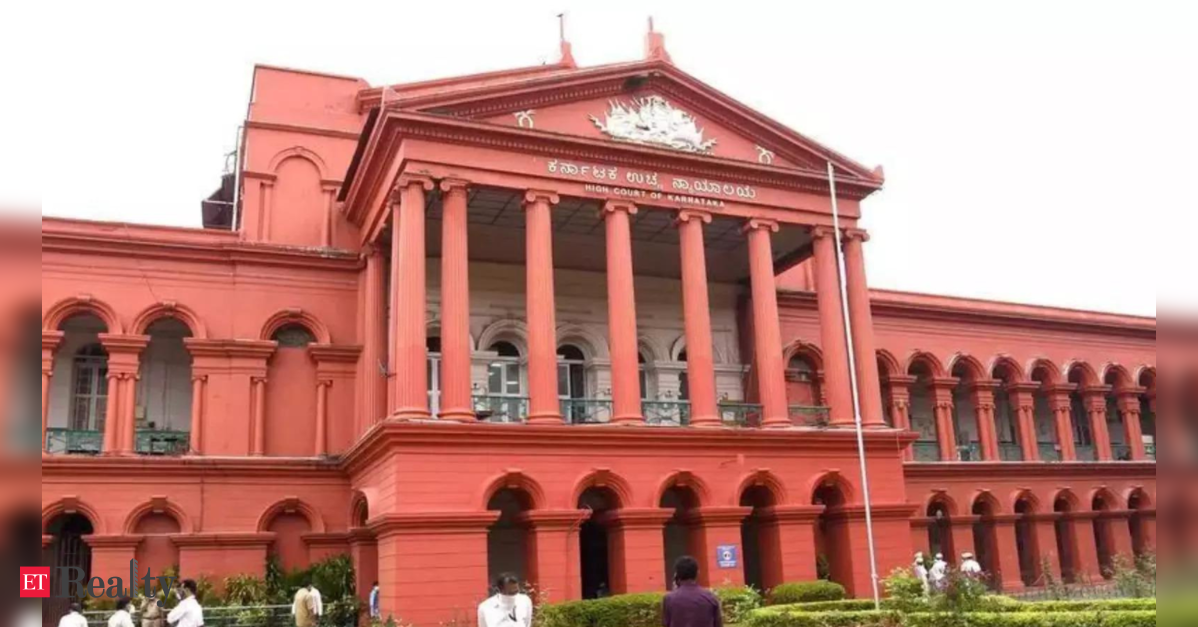

BENGALURU: A recent ruling by the high court confirms that an individual who acquires property through the asset reconstruction law has the right to request the transfer of its khata in their name.
Justice Suraj Govindaraj emphasized that sales under the Securitization and Reconstruction of Financial Assets and Enforcement of Security Interest (SARFAESI) Act, along with the issuance of a certificate, carry a presumption of regularity. This decision comes in response to a petition by Nagabhushana, a resident of Hassan.
Nagabhushana bought a flat located at P&T Colony, Sanjaynagar, Bengaluru, from SV Naresh, who was the successful bidder in an auction conducted by SBI. The previous owner, Revathi, had mortgaged the property to the bank, which led to its auction under SARFAESI due to her failure to repay the loan.
Subsequently, the BBMP (now Greater Bengaluru Authority) canceled the khata and denied Nagabhushana’s transfer application, citing that the building was unauthorized.
The Bescom authorities also disconnected power to the flat in 2024, prompting Nagabhushana to challenge both actions.
Rameshchandra, the petitioner’s lawyer, pointed out that the khata had been assigned to Revathi in 2003 and that objections were only raised in 2011 and 2023. The khata was subsequently canceled in 2023, well past the three-year limit allowed under BBMP regulations.
No claims of fraud or concealment of facts against the previous owner were made, and Rameshchandra argued that Bescom had no grounds to cut power following the khata’s cancellation.
Justice Suraj Govindaraj observed that the alleged illegality associated with the building’s construction could not be used to justify the khata’s cancellation outside the statutory limitation imposed by municipal laws.
The judge ruled that the disconnection of power supply was untenable under the law and ordered immediate restoration of electricity, while also instructing the consideration of Nagabhushana’s khata transfer application.