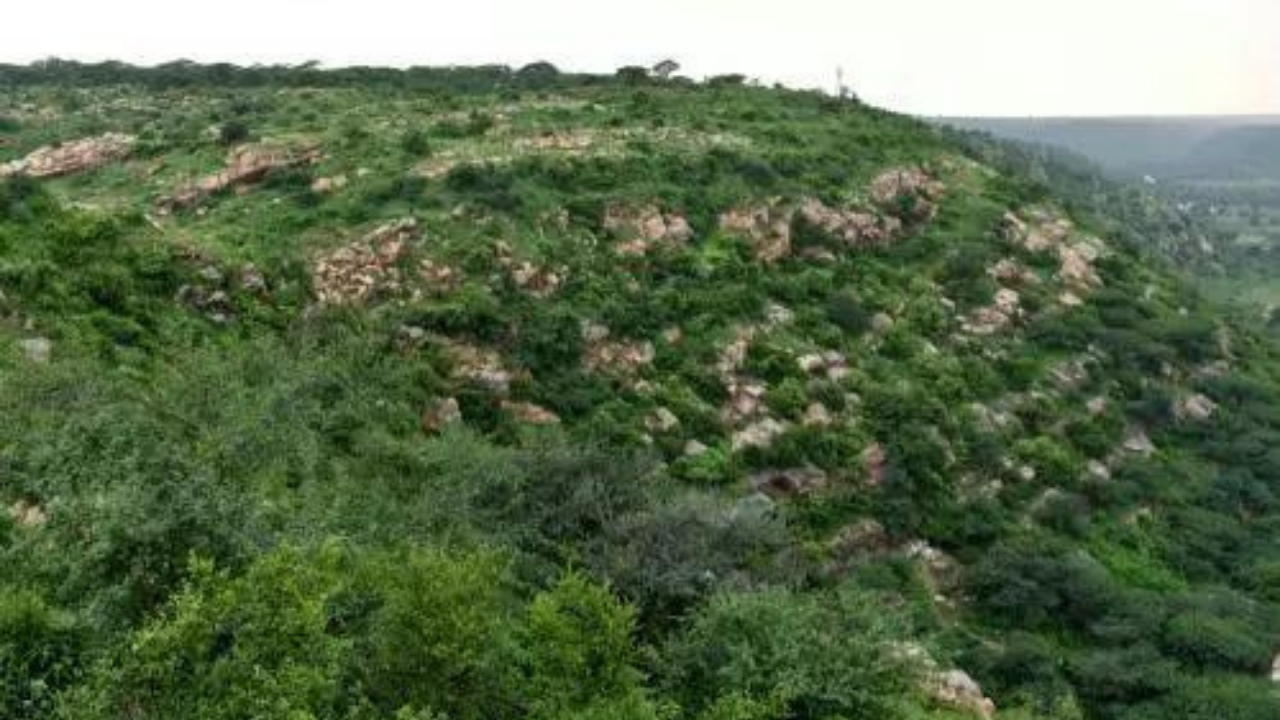
GURUGRAM: The Punjab and Haryana High Court has directed the Haryana government to provide a clear and legally sound definition of the Aravali forest landscape in the state. The case will be revisited on January 9, 2026, during which the government is expected to submit an affidavit “mapping the exact area” of the Aravalis, in accordance with previous Supreme Court rulings and a recent apex court judgment from last month.
The bench, comprising Chief Justice Sheel Nagu and Justice Sanjiv Berry, issued the directive on Tuesday while examining a public interest litigation initiated by activist Harinder Dhingra. They instructed Principal Chief Conservator of Forests (PCCF) Vineet Kumar Garg to submit a “legally defensible” Aravali map, a task the state has not accomplished despite ongoing ecological disputes in Gurgaon, Faridabad, Nuh, and Mahendragarh. The situation is particularly pressing due to pressures from real estate development, road infrastructure projects, mining activities, and attempts to modify land classifications.
PCCF Garg stated that the department would start gathering the necessary information. He informed TOI, “The forest department will request datasets from the mining department and the Haryana Space Applications Centre, review the court’s order once it arrives, and prepare a compliance report within the required timeframe. We also possess data from the Forest Survey of India, which we will analyze prior to submission.”
The affidavit is anticipated to clarify the amount of land classified as forest under the Supreme Court’s interpretation, and it will delineate the boundaries of the Aravali ecosystem as recognized by law, transcending mere revenue classifications. Accurately identifying Aravali forest areas has been pivotal in disputes over the diversion of gair-mumkin pahar land, forest sections falling under the Godavarman case, and regions where the state has been instructed to pause or regulate construction. Dhingra sought clarity on the extent of Haryana’s Aravali land and the level of forest protection across the region.
The bench referenced longstanding directions established by the Supreme Court in the TN Godavarman forest conservation case, which for nearly three decades has dictated how states should identify and protect forest land regardless of revenue classifications.
The High Court also cited the Supreme Court’s judgment from November 29, 2025, in a related interlocutory application concerning the Godavarman case. This order pointedly recognized the definitional void that has allowed different interpretations of the Aravalis by the states.
The apex court noted in paragraph 31: “As against this, Ms Bhati, the ASG, submitted that if the definition of Aravali Hills and Ranges suggested by the FSI is accepted, it would exclude large areas from the Aravali Hills and Ranges. However, she stated that if the definition proposed by the committee is adopted, a larger area would be included as part of the Aravali Hills and Ranges.”
Environmental analyst Chetan Agarwal commented, “This definitional exercise will have major implications. If the 100-meter height criterion is applied, nearly 90% of Haryana’s Aravalis would fall outside the definition. Given the current context, the HC’s directive is crucial as it compels the state to clarify the area using both FSI data and its own records.”