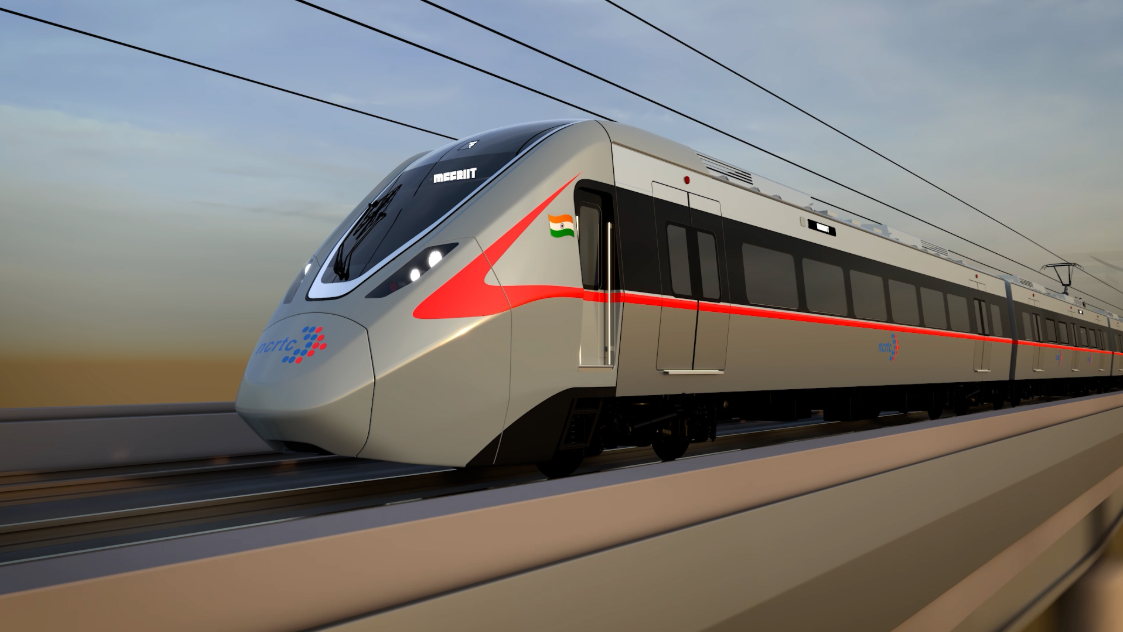
GURUGRAM: The Haryana government has suggested that Rajiv Chowk serve as the starting point for the Gurgaon–Faridabad–Noida Namo Bharat (RRTS) corridor. Officials believe this strategic location will boost ridership throughout the day, enhance multimodal connectivity, and provide significant advantages to commuters.
However, the National Capital Region Transport Corporation (NCRTC) has expressed reservations, citing increased construction costs, engineering obstacles, and the possibility of a detour between IGI Airport’s Aerocity and Noida International Airport.
Disagreements arose during a meeting to finalize the draft detailed project report (DPR) for the corridor. This project is designed as a rapid transit link connecting IGI Airport in Delhi to the Noida airport at Jewar, passing through Gurgaon and Faridabad. According to the draft, the Gurgaon–Faridabad–Noida segment will commence at IFFCO Chowk, pass through Sector 54, enter Faridabad at Bata Chowk, and then move towards Noida sectors 142/168 before connecting with Noida International Airport via Surajpur. The route will feature six stations at an estimated cost of about Rs 15,000 crore, making it the third RRTS corridor in Haryana.
Haryana officials argue that the proposed alignment does not adequately serve the larger population of Gurgaon. They assert that Rajiv Chowk offers a superior catchment area and is more suited to function as a major interchange. As part of the project, Rajiv Chowk is planned to include an underground station on the Delhi–Gurgaon–Manesar–Bawal RRTS corridor, with additional metro connectivity anticipated under the proposed Bhondsi–Gurgaon railway station corridor. A senior official noted, “Rajiv Chowk is centrally located and serves commuters throughout the day, unlike IFFCO Chowk and Golf Course Road, which primarily handle peak-hour corporate traffic.”
Rajiv Chowk is one of the city’s busiest junctions, surrounded by densely populated residential and commercial areas, including Sadar Bazaar, Civil Lines, and various sectors. Administrative offices such as the mini-secretariat, district court, and police commissionerate, along with its proximity to Hero Honda Chowk and industrial clusters, enhance its potential for high ridership. There is also a hospital and a stadium located nearby.
As a vital connector, Rajiv Chowk links major roads like the Delhi–Jaipur highway and the Delhi–Mumbai Expressway, effectively connecting Old and New Gurgaon. Officials believe this enhanced connectivity would lead to the highest all-day ridership, supported by the strong dependency on public transport in Old Gurgaon.
Concerns about a “long detour” are deemed minor, as IFFCO Chowk and Rajiv Chowk are only about 5 km apart. At an operational speed of approximately 180 km/h, the additional distance adds just one to two minutes of travel time, which is negligible considering the potential ridership and integration benefits.
However, NCRTC officials indicated that starting at Rajiv Chowk would increase the project cost by nearly Rs 2,000 crore compared to the initial proposal. The draft report details an initial plan featuring an 11 km fully elevated alignment from IFFCO Chowk through Sector 54, estimated at Rs 2,858 crore. In contrast, an underground alignment from IFFCO Chowk via Sector 53—combining underground and elevated segments—is estimated at Rs 4,180 crore, roughly Rs 1,322 crore more than the original plan. The most costly underground option that starts at Rajiv Chowk via Sector 54 is estimated at Rs 4,825 crore, nearly Rs 2,000 crore above the initial proposal. NCRTC has also cautioned that this plan could disrupt NH-8 traffic for nearly three years during construction near Rajiv Chowk.