GURUGRAM: The city is continuing to extract significantly more groundwater than it can sustainably replenish, with withdrawals reaching 194.6% above the allowable limit, as per the latest National Compilation on Dynamic Ground Water Resources of India, 2025, published by the Central Ground Water Board (CGWB).
While this marks a slight decrease from 2024, when extraction was recorded at 195%, the change is minimal and raises concerns about the ongoing imbalance between extraction and natural replenishment. In fact, in 2023, the extraction rate was even higher at 212%.
The report reveals that the city drew 40,396 hectare-metres (ham) of groundwater, against a sustainable extractable total of 22,923 ham. This alarming trend persists despite ongoing warnings from the National Green Tribunal and environmental activists regarding the depletion of this vital resource. Recently, the tribunal criticized the Haryana government for its ineffective measures against illegal groundwater extraction and mandated inspections of construction sites, farms, industrial units, educational institutions, and pharmaceutical facilities to identify unlawful borewells.
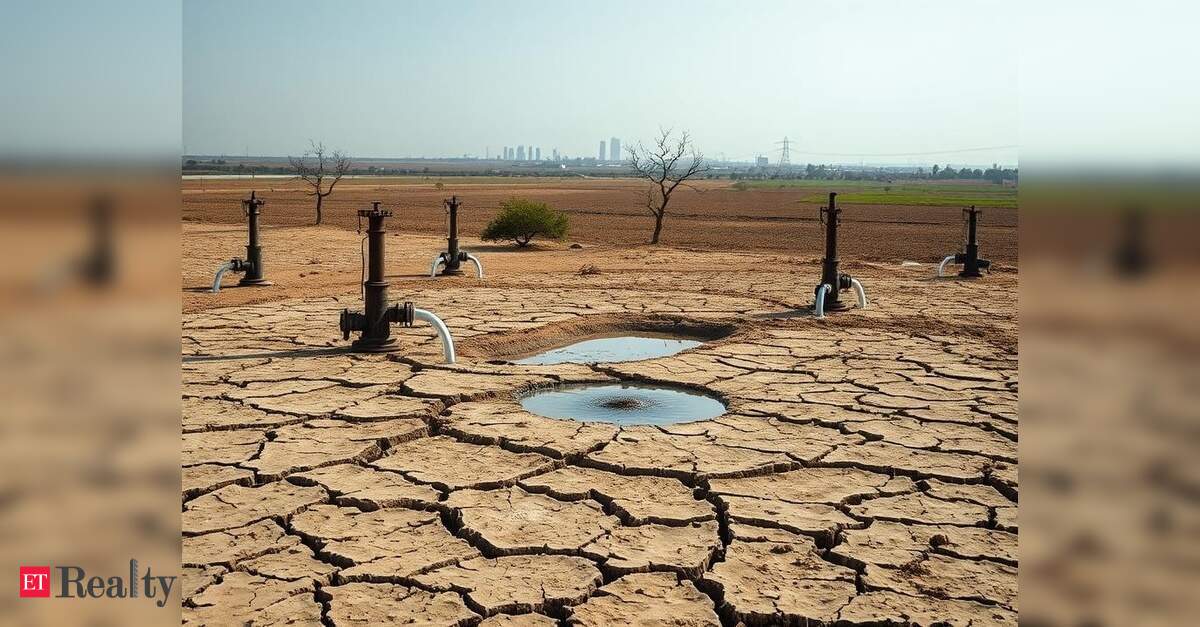
Extraction beyond the 100% threshold is classified as “over-exploited,” indicating that aquifers are being consumed faster than they can naturally refill.
A hectare metre (ham) measures large water volumes, equating to 10 million litres. This means the city extracts approximately 403 billion litres annually, nearly double the sustainable supply from its aquifers.
Throughout Haryana, several districts are experiencing significant groundwater stress. Panipat has the highest extraction level at 217.8%, followed closely by Karnal at 196.9%. Other districts with elevated extraction rates include Fatehabad (175.3%), Mahendragarh (156.8%), Faridabad (139.6%), and Ambala (130.1%), as per the report.
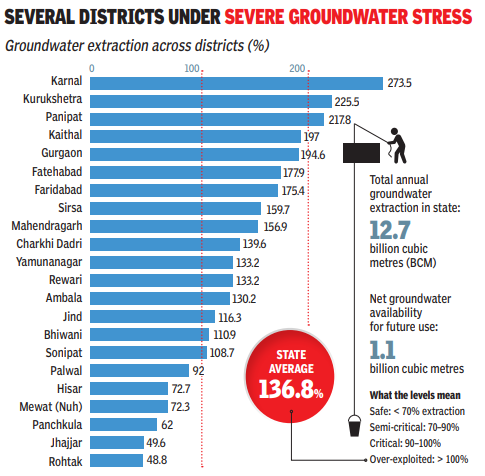
Conversely, some districts exhibit comparatively safer extraction levels. Rohtak, for instance, has an extraction stage of 48.8%, whereas Panchkula is at 62%, Jhajjar at 72.7%, and Nuh (formerly Mewat) at 72.3%, indicating lower groundwater stress.
The data also indicates that industrial demand constitutes a substantial portion of groundwater extraction in the city, with industrial usage accounting for about 17,142 ham, while domestic consumption is approximately 5,191 ham. Irrigation purposes use over 21,267 ham, particularly in peri-urban villages.
The report underscores that groundwater recharge in the region heavily relies on rainfall. Monsoon season contributes about 9,567 ham of recharge, with additional sources like canals and return flows adding around 7,002 ham. During non-monsoon periods, rainfall provides only about 3,206 ham, highlighting the region’s dependence on seasonal rainfall for aquifer replenishment.
In Haryana, groundwater extraction has reached around 136% of its annual recharge capacity. The state estimates an annual extractable resource of approximately 9.3 lakh ham, while actual extraction is around 12 lakh ham.
The CGWB assessed 143 groundwater assessment units across Haryana, classifying 88 (61.5%) as “over-exploited,” 11 as “critical,” and eight as “semi-critical,” leaving only 36 units (25.1%) designated as “safe.”
Experts attribute the strain on the city’s aquifers to rapid urbanization, industrial growth, and a burgeoning population, all of which significantly increase water demand. Many areas still rely on private borewells, especially in industrial, commercial, and residential zones where piped water supply is insufficient.
Currently, the city receives around 570 million litres per day (MLD) of treated surface water, which is inadequate compared to its peak summer demand of approximately 675 MLD. This deficit forces residents and industries to increasingly rely on groundwater, according to experts.
Professor Gauhar Mahmood from Jamia Millia Islamia’s civil engineering department echoed these concerns, stating, “The small improvement in water levels can be attributed to natural factors. The city uses more groundwater than it recharges. Groundwater is not an infinite resource that we can exploit endlessly without consequences.” He also pointed out that the city does not adequately harvest or utilize rainwater for aquifer recharge.