
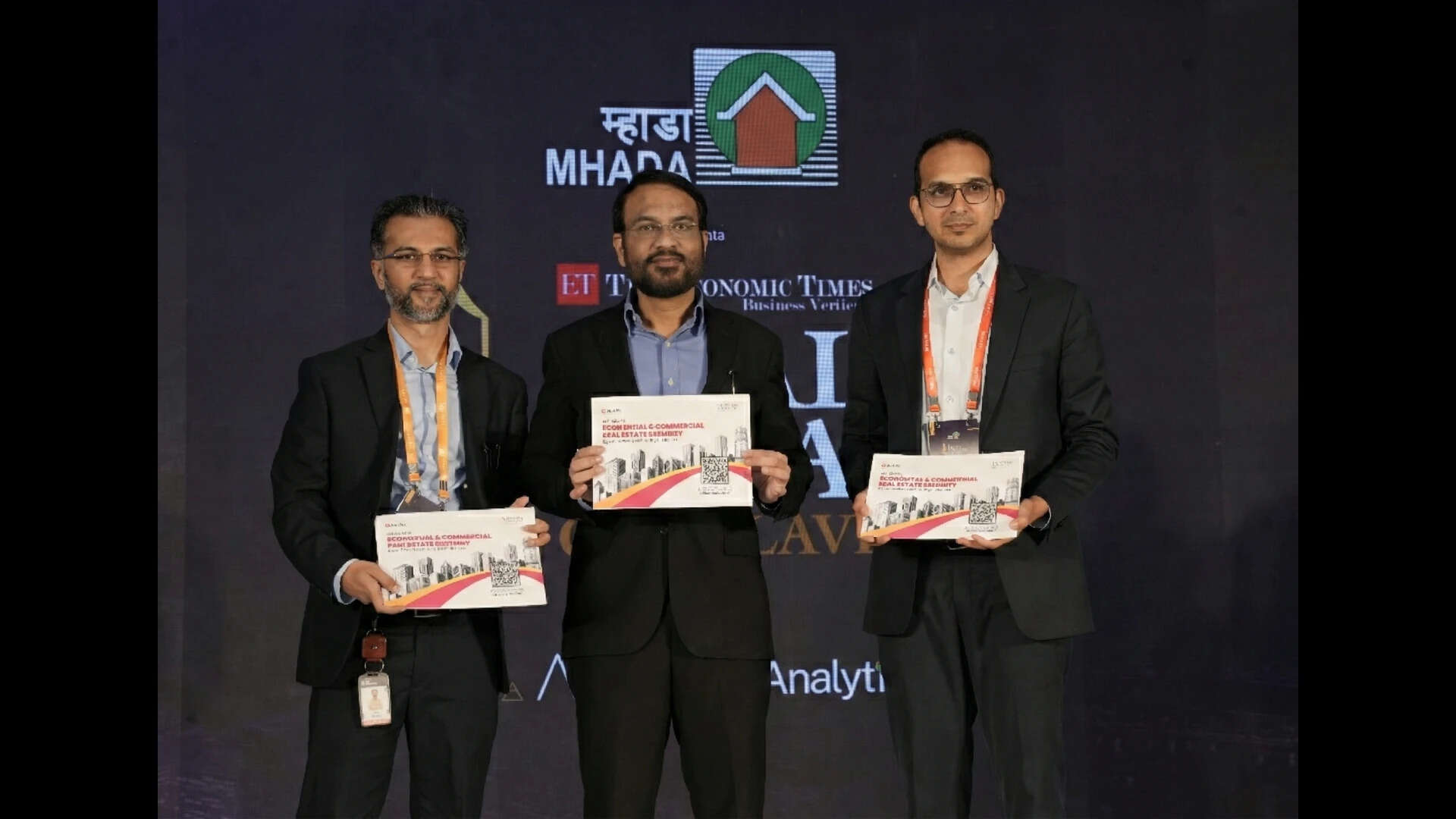
NEW DELHI: India’s commercial real estate sector is expected to maintain steady growth, with gross leasing across the top eight office markets projected to increase by 12%–14% year-on-year, reaching 85-90 million sq ft in FY27, as stated in a whitepaper from India Ratings & Research (Ind-Ra) in partnership with ETRealty.
According to the agency, gross leasing is set to reach 79–80 million sq ft in FY26, reflecting a 10% annual increase. Although leasing for the first half of FY26 was recorded at 29.5 million sq ft, which is an 8% drop year-on-year due to a high base and limited availability of grade-A spaces in prime markets, Ind-Ra anticipates a resurgence in activity in the latter half of FY26 that will carry forward into FY27.
Demand Driven by GCCs; Rise of Flexible Spaces
Global capability centres (GCCs) will remain the primary demand drivers, contributing 35–45% of annual leasing in 2025. The expansion of GCCs in sectors like technology, BFSI, and engineering, along with larger deal sizes, is expected to fuel absorption in FY27.
Domestic occupiers from IT-BPM, BFSI, manufacturing, and flex workspace sectors continue to be significant demand contributors. Despite slower hiring within large IT firms and productivity improvements attributed to AI, the leasing activity driven by GCCs is stabilizing overall absorption.
Flexible and managed office formats are transitioning from optional features to essential components of leasing strategies. India now leads the flex workspace market in Asia-Pacific and is projected to exceed 100 million sq ft of flex stock by 2026. Ind-Ra notes that adopting flexible workspaces facilitates quicker portfolio adjustments for occupiers, enhancing their speed-to-market and agility.
City-Specific Trends: Easing Supply Constraints
Leasing trends varied across cities in H1 FY26. Pune (up 37% year-on-year), Hyderabad (up 18%), and Kolkata (up 35%) performed notably well, while the Mumbai Metropolitan Region (MMR), Bengaluru, Chennai, NCR, and Ahmedabad experienced moderation, reflecting a natural correction from last year’s peaks.
Ind-Ra expects MMR, Bengaluru, and Chennai to experience a 15–25% year-on-year increase in absorption during FY27, supported by active project pipelines and GCC-led demand. Many deferred demands from H1 FY26 are anticipated to materialize as developments are completed through FY26–FY27.
Disciplined Supply Growth; Total Stock to Reach 1.5 Billion sq ft
Office space in the top eight cities is projected to hit 1,391 million sq ft by March 2026 (a 9% year-on-year increase) and grow to 1,507 million sq ft by March 2027 (an 8% increase). The FY26 supply is expected to be primarily driven by the completion of committed projects, with a cautious approach to pipeline rebuilding in FY27.
As of H1 FY26, total stock was approximately 1,300 million sq ft. The ready stock rose by 12% year-on-year while under-construction (UC) inventory fell by 14%, lowering UC’s share from 16% to 13%. By FY27, UC’s share should inch up to 15-16%, remaining below the 19-21% levels from 2023, indicating a careful approach to additions.
India is projected to account for around 40% of Asia-Pacific’s grade-A office completions in 2026, primarily fueled by Bengaluru, NCR, and Mumbai.
Rental Rates to Normalize Following FY26 Spike
Nationwide office rentals are anticipated to rise by 5-7% in FY26 before settling at a growth rate of 4–6% in FY27.
In H1 FY26, Bengaluru and Hyderabad showed sharp rental increases of 12% and 10% year-on-year, respectively, due to tight availability of ready-to-occupy spaces in key tech areas. MMR and NCR grew by 4%, while Pune saw a 5% rise, indicating robust demand in prime sub-markets.
Ind-Ra predicts a slowdown in rental growth in FY27 as new completions alleviate supply bottlenecks, especially in tech-heavy regions. Major markets such as Chennai, NCR, MMR, Bengaluru, and Pune are expected to experience a rental growth of 3-4%, whereas supply-catch-up markets like Hyderabad and Ahmedabad may see growth of 1-2%.
Certain prime, green-certified, and amenity-rich properties are likely to maintain their pricing power as occupiers continue to prefer high-quality spaces.
Vacancy Rates to Remain Stable
Vacancy rates in most top cities are projected to remain in the 12-18% range during FY27, buoyed by consistent leasing activities and a return-to-office trend.
Vacancies fell in six out of the eight tier-I cities in H1 FY26 compared to FY25. However, Pune and Ahmedabad saw an increase to 23% and 25%, respectively, due to a rise in inventory amid moderate absorption levels.
Ind-Ra expects overall vacancy rates in most cities to decline by 1-4% year-on-year in FY27, with Kolkata potentially experiencing a more significant contraction due to limited new supply.
AI: A Two-Speed Effect on Demand
The whitepaper outlines a shifting risk due to AI adoption in the IT sector. While AI-driven productivity improvements could slow expansion for traditional IT firms and encourage densification or managed solutions, GCCs and flex operators are still expanding their presence.
This evolving landscape creates a divergence between institutional Grade A assets and mid-tier properties in weaker micro-markets. Owners of high-quality, ESG-compliant assets with stable tenant profiles are likely to capture the primary GCC- and flex-led demand, whereas mid-tier assets may face slower leasing rates and weakened rental growth.
Strengthening Credit Metrics
Increasing occupancy rates (90-95%), contractual rent escalations, and market-adjusted rental uplifts are expected to enhance revenue and EBITDA growth for commercial real estate companies in FY27.
Ind-Ra cites stable net leverage ratios of 4.5x–5.5x and interest coverage ratios of 2.0x–2.25%, bolstered by strengthened cash flows and solid pre-commitments. Regulatory measures enabling bank investments in REIT units are anticipated to increase liquidity and improve refinancing opportunities for Grade A properties.
In summary, the overall outlook indicates that while AI and slowed IT hiring may influence space utilization patterns, India’s office market is structurally supported by GCC expansions, flexible workspace adoption, and disciplined supply strategies, positioning FY27 as a year of steady, quality-driven growth rather than cyclical fluctuations.