

MUMBAI: There are concerns that thousands of property transactions nationwide may have escaped the notice of tax authorities.
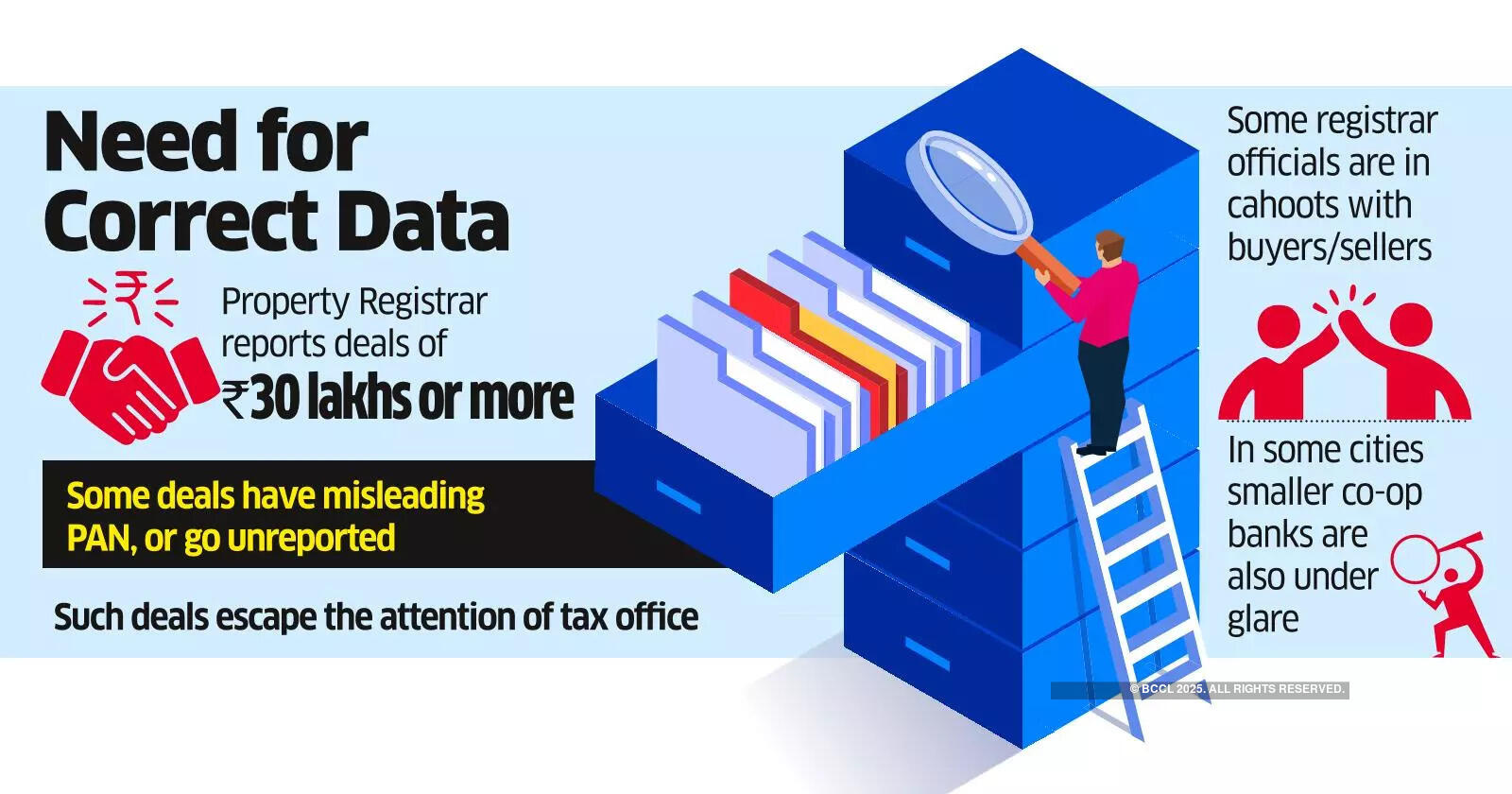
Intentional reporting omissions, along with fictitious or incorrect Permanent Account Numbers (PANs) associated with buyers and sellers in property documents, have allowed many deals to evade scrutiny from the Income Tax (I-T) department.
Officials from the investigation wing of the tax office are currently reviewing records from property registrars for verification.
Registrars are mandated to report transactions involving properties valued at ₹30 lakh or more.
In some instances, parties, in collusion with certain registrar officials, have ensured that transactions remain unreported or are registered under incorrect names or PANs, complicating traceability.
“This initiative appears to be a part of a larger national strategy aimed at reducing benami transactions and unaccounted wealth. High-value real estate transactions often serve as a conduit for laundering black money, typically hidden through proxies or shell companies. A crucial reform to consider is implementing mandatory e-verification of PAN and Aadhaar for all parties before property registration. This could help eliminate the use of fake or incorrect identification details, improve traceability, and ensure property records reflect legitimate ownership, thereby discouraging tax evasion,” stated Ashish Karundia, founder of Ashish Karundia & Co.
Earlier this year, the I-T department carried out a nationwide investigation targeting individuals and entities reporting agricultural income of ₹50 lakh or more without owning land, while also scrutinizing cases of inflated farm income exceeding ₹5 lakh per acre that diverged from prevailing trends and publicly accessible data.
Tax officials have been analyzing property records from registrars in cities like Varanasi, Lucknow, Gorakhpur, Kanpur, and Bhopal.
The department has instructed its field teams to conduct inspections and surveys after data analysis. “This initiative is part of the department’s ‘nudge campaign’ to enhance compliance and encourage voluntary disclosures,” noted an official familiar with the situation. “As a result, many field teams are conducting over two dozen inspections and surveys,” the official added.
Under Rule 114E of the I-T Rules, banks must report details of substantial cash deposits and withdrawals by account holders to the tax office.
Manish Dafria, managing partner at V.K. Dafria & Co., a CA firm in Indore, noted that, similar to property transactions, the tax department has indications that certain banks—especially smaller cooperative banks with weaker internal controls—are failing to report large cash transactions by account holders.
In recent months, officials from the Intelligence and Criminal Investigation wing of the I-T department have conducted outreach programs in cities like Indore, Bhopal, Lucknow, and Jaipur to emphasize the importance of accurate reporting. “This was succeeded by surveys at several cooperative bank head offices, where discrepancies between actual cash deposits or withdrawals and reported figures were discovered,” Dafria mentioned.
Information provided by banks and registrars is included in taxpayers’ Annual Information Statements, and this data, when compared against a taxpayer’s overall profile, aids in selecting returns for scrutiny and reassessment. “Thus, it is crucial for the department to receive precise data from the source regarding all reportable transactions,” he added.