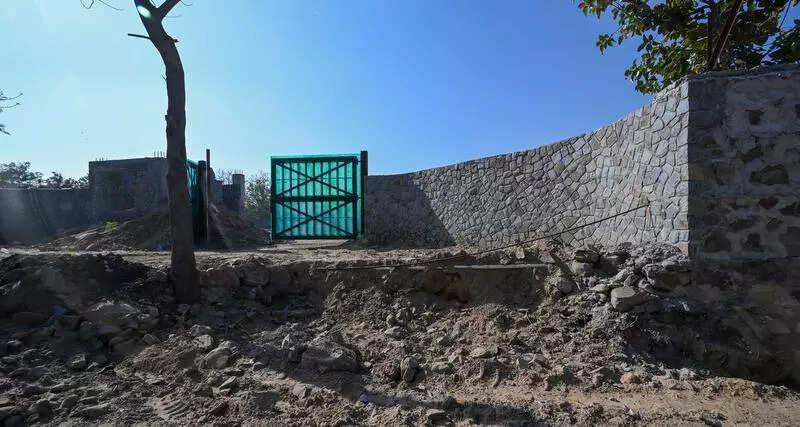
GURUGRAM: The Central Empowered Committee (CEC) has presented a report to the Supreme Court regarding encroachments in the Aravali region of Faridabad. The report recommends distinguishing between legitimate homes in village abadi areas and other unlawful constructions to protect residents’ rights. It advised that significant projects and farmhouses on forest land should be addressed according to regulations.
“The district authorities, in collaboration with local representatives, must meticulously differentiate between unauthorized structures and genuine residences, ensuring that any demolitions respect the rights and safety of law-abiding residents. An alternative strategy is being considered to create a defined perimeter around existing settlements, in consultation with the MoEFCC (Union Environment Ministry),” stated the report dated August 29.
Experts expressed concerns that attempts to regularize illegal village settlements in the Aravalis could result in the permanent loss of considerable forest land to development.
“Legally, it’s not permissible. However, on humanitarian grounds, if there are homes belonging to lower or middle-class families who have invested their savings, this may be taken into account. Ultimately, the CEC can only make recommendations; these must be approved by the Supreme Court,” explained Gaurav Kumar Bansal, a Supreme Court attorney.
Environmentalists warned that unchecked construction has already harmed the Aravali ecosystem in Faridabad. “The longer authorities delay definitive action, the more challenging restoration will become,” cautioned ecologist and wildlife expert Sunil Harsana.
The CEC report indicates that there are at least 5,800 houses built on 168 acres of forest land in Faridabad’s Anangpur.
These findings follow a directive from the Supreme Court for the CEC to evaluate compliance with its 2022 order mandating the restoration of all forest land. The court noted that “the implementation process has been very slow” and requested a compliance report.
In July 2022, the Supreme Court directed the Haryana government to remove all illegal constructions on Aravali land classified under sections 4 and 5 of the Punjab Land Preservation Act (PLPA). Under these provisions, the land is protected as ‘forest,’ restricting non-forest activities.
The Haryana Forest Department reported that illegal construction is prevalent in the protected Aravalis of Ankhir, Anangpur, Lakkarpur, and Mewla Maharajpur in Faridabad. However, the state has only managed to demolish a small percentage of these encroachments, largely due to interim stays issued by courts in cases involving individual property owners contesting demolition efforts.
The CEC also suggested granting retroactive approvals for government constructions on forest land in these four Aravali villages.
“Several structures belonging to government agencies, including the Haryana Shahri Vikas Pradhikaran, Haryana Tourism, the police department, and the municipal corporation, have been built on lands designated under sections 4 and 5 of the PLPA, violating provisions of the Van (Sanrakshan Evam Samvardhan) Adhiniyam, 1980. Since these structures belong to government bodies, their proposals may be eligible for post-facto approval,” it stated, while advising against any new construction.
The committee’s findings will be reviewed by the Supreme Court, which is set to revisit the case on September 8.