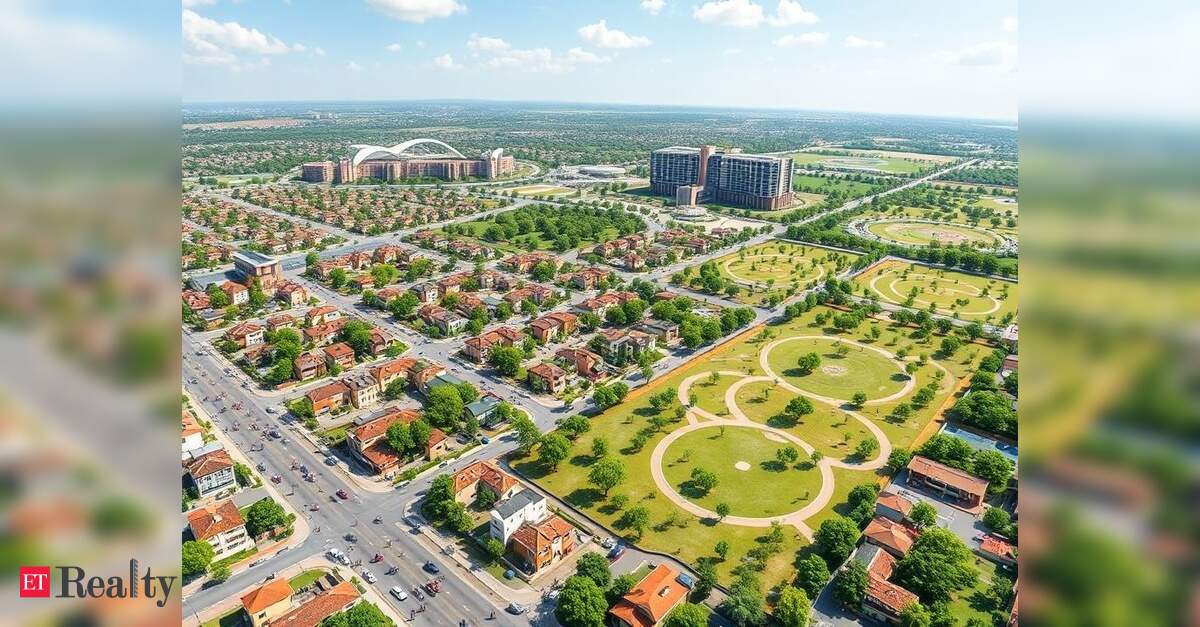

NEW DELHI: India’s residential real estate sector is currently experiencing a price-driven consolidation phase following a robust rebound post-pandemic. While sales activity remains steady, significant increases in land and construction costs, particularly in key markets like Gurugram, are beginning to impact affordability and buyer decisions. Developers are reevaluating their product offerings, anticipating a gradual shift back to mid-segment housing as luxury demand stabilizes, coupled with discussions around policy measures aimed at enhancing affordability.
In an exclusive discussion with Ankit Sharma, Parveen Jain, President of Naredco National, elaborates on how soaring land prices and escalating construction costs have altered housing economics, why developer margins have largely remained stable despite apparent price increases, and how industry bodies are collaborating with the Haryana government on policy initiatives like higher density regulations and incentives for first-time homebuyers. Jain also shares insights on funding conditions, trends in institutional investment, sustainability guidelines, and the influence of large outstation developers on local markets. Edited excerpts follow:
Reflecting on the housing market in 2025:
Overall, 2025 showed decent performance, although 2024 was stronger. By 2025, end-user demand cooled as prices surged significantly. Land prices in Gurugram have skyrocketed over recent years, with some micro-markets seeing values that rose from ₹7 crore per acre in 2021 to as much as ₹60 crore today. Such steep land costs inevitably lead to higher housing prices.
Has there been a rise in construction costs as well?
Absolutely, construction costs have increased by about 25-30%. If the cost index was 100 before, it’s now around 130. Additionally, buildings have become taller due to increased Floor Area Ratio (FAR) and Transferable Development Rights (TDR); structures that once stood at 15 floors are now reaching heights of 30 to 50 floors. This height increase naturally boosts construction and service costs.
Are developers enjoying higher margins due to this price surge?
Margins for developers haven’t seen a significant rise; most still operate within the 10-12% range. However, from the buyer’s perspective, seeing a ₹2 crore home escalate to ₹4 crore in just a few years can be a considerable shock to affordability.
Why is affordable housing not expanding more rapidly?
The challenge lies in the skyrocketing land costs, which make it hard to meet the price brackets established by the government. Policy adjustments are essential for affordable housing to regain its viability.
Considering the disparity between rising prices and stagnant salaries, do you anticipate a slowdown in home buying in 2026?
I believe that demand for mid and affordable housing remains, but the issues are related to product availability and feasibility. The market shifted towards luxury homes post-COVID due to limited inventory and buyer preferences for spacious, amenity-rich options. However, the growth of luxury buyers is unlikely to continue at the same pace. I foresee a rise in mid-segment launches in 2026 compared to the previous cycle which concentrated on premium offerings.
What steps can be taken to make mid-segment housing viable, especially in Gurugram?
Legislative adjustments could assist significantly. For instance, allowing higher density for mid-segment housing. Currently, higher density is permitted for affordable housing, but not for mid-segment. If the government were to increase permissible density, developers could create smaller, more affordable units within the same land area. We have been advocating for this with the government.
How does increasing density contribute to affordability?
By increasing density, you can construct more units per acre. For illustration, if before there were 100 homes built on an acre, you could potentially build 200 with the same land. This would allow for smaller unit sizes and more manageable price points.
What is Naredco’s proposal?
We are advocating for higher density limits, aiming for up to 600 units. Even if the government agrees to a lower figure, it will still be beneficial. The goal is to create a middle-ground where mid-segment housing becomes feasible.
Institutional investments in real estate have slowed. Has this affected funding for residential developers?
Not significantly. Residential developers primarily require land capital first, which institutions typically don’t finance. For construction, banks in India are once again providing loans, and interest rates have decreased following repo rate cuts. Moreover, many projects rely on customer collections for construction funding after a project launches. Thus, residential funding hasn’t faced a major setback.
Why do you think institutional inflows have decreased?
In many instances, developers simply did not require it. There were some currency fluctuations, but I won’t elaborate on international capital. In Gurugram, several developers who launched projects opted not to seek external funding.
What’s your perspective on the Haryana government’s handling of EDC recovery issues?
The government has previously offered extensions, which we requested and received in phases. Regarding recovery, it’s essential to examine the complete dataset, rather than focus on a few large defaulters. If you exclude a small number of extreme cases, the majority of the industry has resolved their payments.
Some developers in Gurugram believe that larger outstation developers with greater financial resources are inflating land prices, potentially squeezing local players. Do you concur?
Real estate remains fundamentally a regional business. Many large developers who attempted pan-India expansion previously faced losses. The new entrants often target smaller, approved parcels—ranging from one to three acres—sometimes bidding much higher than current benchmarks. Whether this approach is sustainable will become evident when the projects are delivered. Additionally, quality and local execution are pivotal.
Does their aggressive bidding impact local developers presently?
Opportunities still abound in Gurugram. The demand for work remains strong, and there is capacity for more players. Hence, I do not foresee local developers being immediately displaced.
How can local developers compete against those selling homes at higher price points?
Efficiency is crucial. If, in the same area, a competitor sells homes for ₹100, a local developer might sell theirs for ₹60 by managing costs better, as they may not be paying a contractor’s margin and can execute projects in-house. This edge significantly benefits buyers and ensures sustainability.