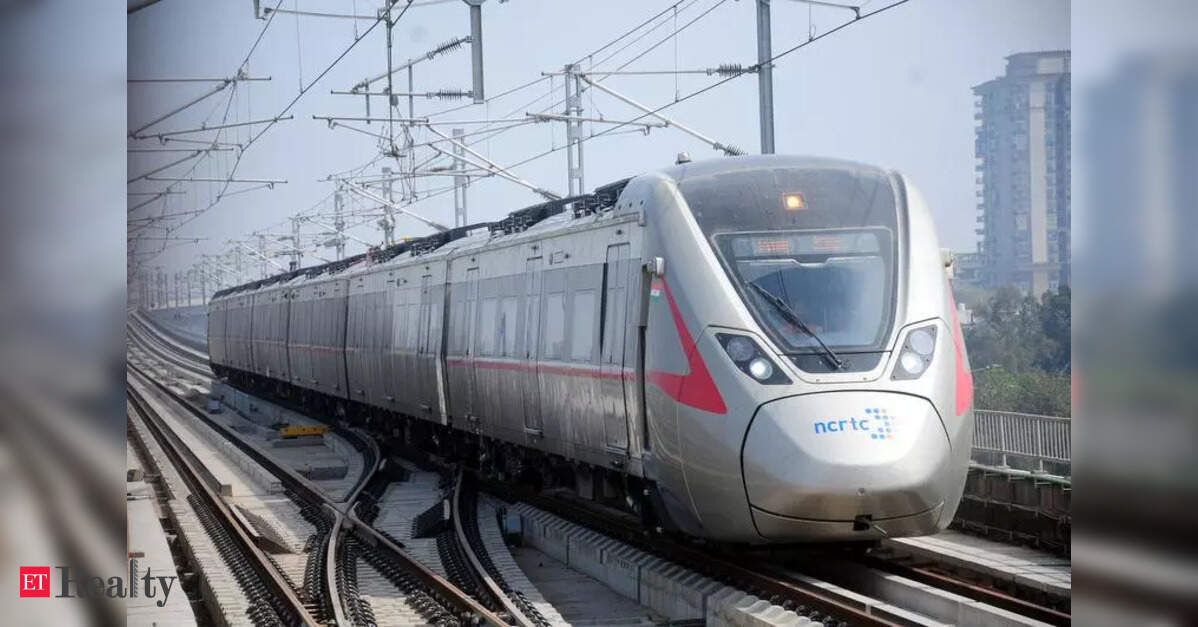
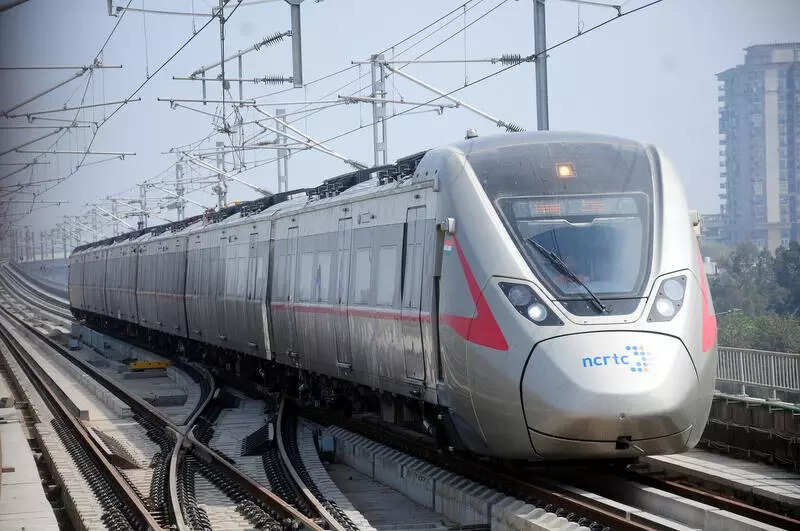
GURUGRAM: The NCR Transport Corporation has presented a draft detailed project report (DPR) to the Haryana government for a rapid rail corridor connecting IFFCO Chowk in Gurgaon to Surajpur in Greater Noida.
This corridor is essential for the Central government’s vision of a high-speed rail link between Delhi’s IGI airport and the future Noida International Airport in Jewar.
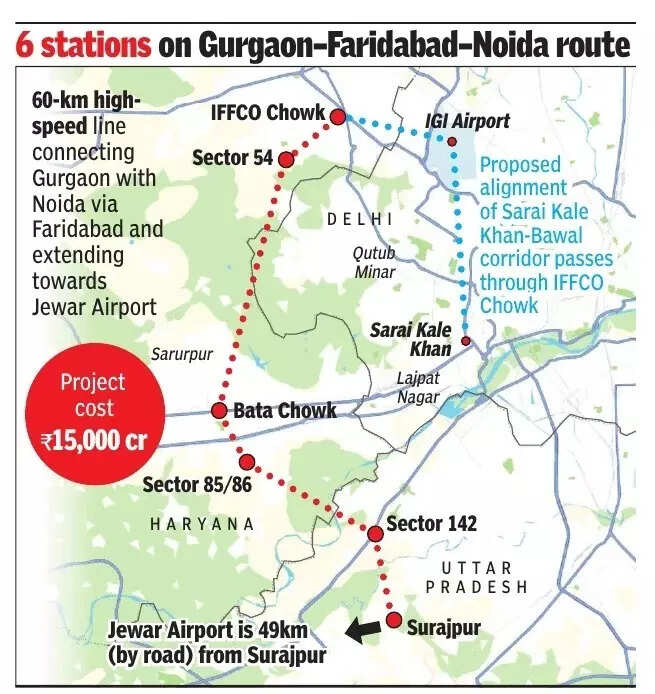
The DPR has been submitted for the Haryana government’s feedback. As outlined in the draft, the corridor will traverse Sector 54, enter Faridabad at Bata Chowk, and continue through the Sector 85-86 intersection towards Noida sectors 142/168 before reaching Surajpur. The corridor, featuring six stations, will bypass Delhi and is projected to cost approximately ₹15,000 crore, marking it as the third RRTS corridor under consideration in Haryana.
The previously proposed corridors, namely Delhi-Gurgaon-Manesar-Bawal and Delhi-Panipat-Karnal, have received approval from the public investment board and await the final nod from the Union Cabinet. The Delhi-Bawal corridor (93km) is estimated at ₹32,000 crore, while the Delhi-Karnal connection (136km) is projected at ₹33,000 crore. Both corridors will start at Sarai Kale Khan, the terminal station for the completed Delhi-Meerut RRTS line, which is awaiting commissioning.
The Central and Uttar Pradesh governments are also examining potential RRTS corridors from Sarai Kale Khan to Jewar or from Ghaziabad to Jewar. Adjustments may be made based on which corridor passes the feasibility test. The Gurgaon-Noida RRTS corridor will connect with the Delhi-Bawal corridor, featuring a station at IGI, at IFFCO Chowk. Surajpur will also serve as a station on the Ghaziabad-Jewar RRTS corridor.
A ride on the RRTS from IFFCO Chowk to Faridabad is expected to take just 22 minutes, and to Noida, 38 minutes, significantly enhancing commuting in the NCR and relieving pressure on the Delhi transport system.
The NCRTC plans to construct the corridor as an elevated line, but the Haryana government has suggested an underground option in Gurgaon due to high land costs and dense urbanization.
This project was a topic of discussion at a recent meeting attended by representatives from NCRTC, HSVP, FMDA, GMDA, GMRL, and HMRTC. Senior officials from Haryana expressed concerns about the feasibility of an elevated high-speed corridor with only one or two stations in Gurgaon, deeming it insufficient for local commuters. They argued that an underground option would better preserve surface land for future urban needs.
An NCRTC official mentioned that discussions are still in preliminary phases and that they have reached out for feedback from all stakeholders. The Haryana government is wary that elevated RRTS tracks could impede future development of already congested corridors, which may soon require flyovers, multi-level junctions, pedestrian infrastructure, and integrated bus systems. An elevated structure could restrict surface-level upgrades and cause prolonged traffic disruption during construction.
Additionally, there are considerations regarding the potential increase in city stations. Urban mobility expert Ashok Bhattacharjee noted that the decision between underground and elevated systems hinges on cost, land availability, and urban context, rather than on technology. “The real constraints are cost implications and right of way. Each mass transit corridor should ideally have multiple stations in proximity to where people live and work,” he stated.
He further cautioned that having limited stations may fail to encourage commuters to shift from private vehicles. “A substantial working population in Gurgaon will only transition to public transport if stations are conveniently accessible. A station serving a sparse area within a 3-5 km radius is unlikely to attract users.” The priority, he emphasized, should be on effectively serving the community rather than merely operating a transit system.