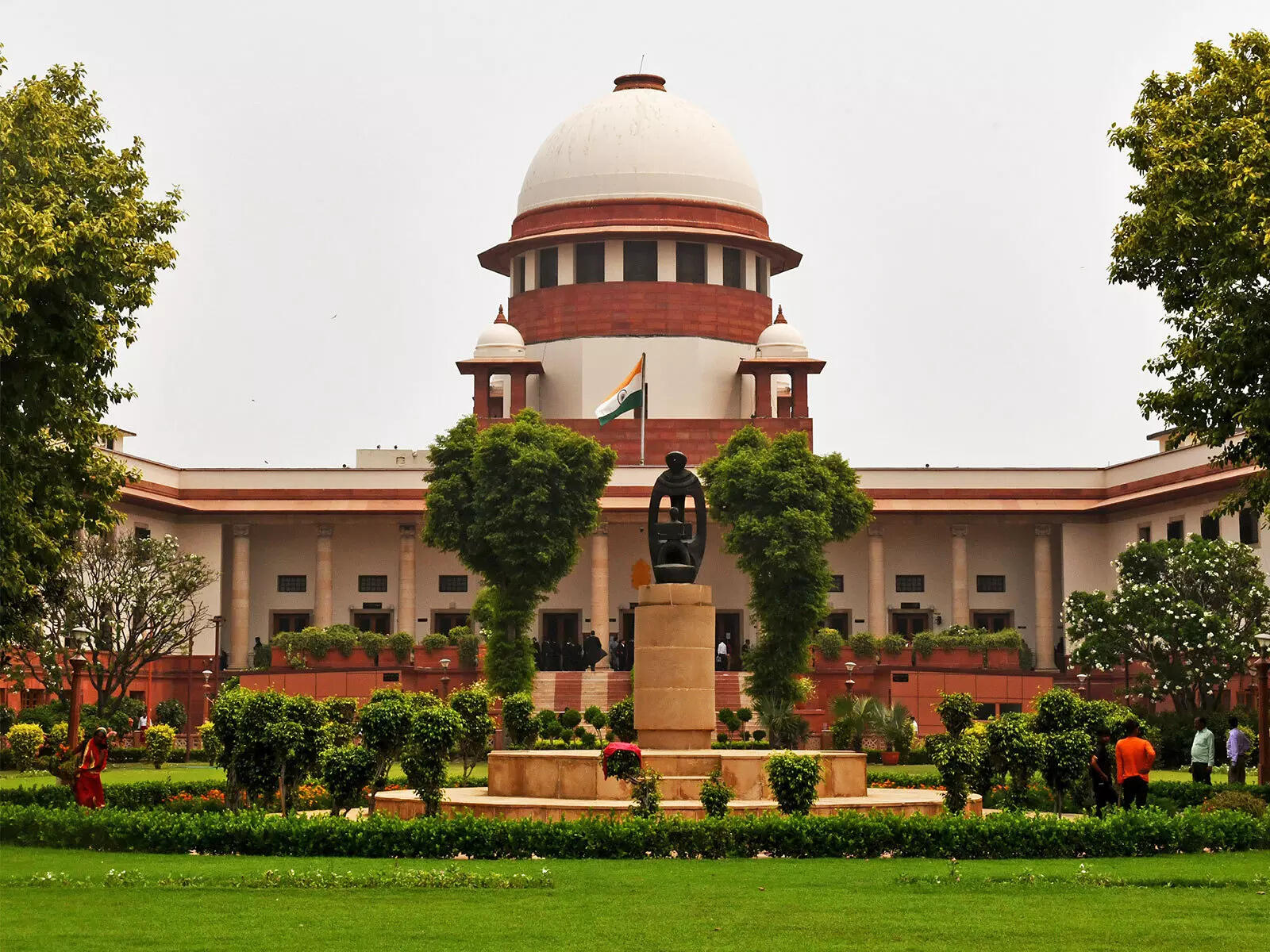
NEW DELHI: The Supreme Court on Thursday granted temporary relief for one week to two petitioners whose properties in Uttar Pradesh are slated for demolition. The court directed that the current state of affairs be preserved until the specified time.
A bench comprised of Justices Vikram Nath and Sandeep Mehta instructed the petitioners, who claimed that partial demolition of their residential or banquet hall properties had already occurred, to seek further orders from the Allahabad High Court.
The court cited the ongoing partial demolition as the basis for granting this week of interim relief.
“Taking into consideration the aforementioned scenario, we grant temporary protection for a week, during which the current situation shall be maintained by all parties involved,” the bench articulated.
The Supreme Court clarified that its interim order would not influence the Allahabad High Court’s consideration of the petition and its associated requests on their individual merits.
The order arose from a petition aiming to halt further demolition of the petitioners’ residential or event hall structures, emphasizing the need for adherence to legal processes.
The bench initially questioned the petitioners’ counsel regarding their decision to approach the Supreme Court first rather than the Allahabad High Court.
The counsel responded by highlighting the apex court’s previous consideration of “bulldozer justice”.
“The court has already delivered a detailed judgment. You should present your case to the high court and leverage that ruling. What is the reasoning behind your approach here? Why should you invoke (Article) 32 repeatedly?” the bench challenged.
“It’s not that the Allahabad High Court disregards requests of urgency; you just need to make a mention,” the bench remarked.
The counsel expressed intentions to approach the high court while requesting a 15-day protective order from the apex court.
“If we grant temporary relief from this court, it will set a precedent, with everyone seeking a directive and protective order here to approach the high court. You should directly proceed to the high court for suitable orders,” the bench advised.
The counsel pointed out that the Supreme Court has broad authority and has entertained similar matters before; the bench responded, “We can address all matters, which would render Article 226 redundant.”
The counsel further noted that one petitioner was a 75-year-old man who had implored officials to provide notice and a hearing, yet no notice was delivered.
“Is this how the law operates in our country?” he argued.
The bench reiterated that these arguments could be presented before the high court.
Concerned about imminent demolition, the counsel noted that authorities were present with bulldozers ready to act.
In response, the bench confirmed, “We will provide you protection for one week. Approach the high court and make your case.” They assured that such matters are prioritized on the day they are mentioned in high court.
The bench declined to process the petition under Article 32 of the Constitution, allowing petitioners to approach the jurisdictional high court under Article 226 instead.
“The petitioner has the right to request urgent listing of their matter due to the ongoing demolition process, especially since partial demolitions have already begun,” stated the bench.
The counsel argued that the actions taken by the authorities constituted contempt in light of the Supreme Court’s previous order on the demolition issue.
“If you wish, you can initiate a contempt petition,” the bench replied.
In a landmark ruling last November, the Supreme Court established pan-Indian guidelines stating that no property should be demolished without a prior show-cause notice, allowing the affected individuals 15 days to respond. The court emphasized that the executive cannot wield judicial powers to penalize citizens through property demolitions without due process, labeling such actions as “high-handed and arbitrary”, necessitating strict legal oversight.
The guidelines exclude unauthorized structures located on public property—such as roads, streets, footpaths, or near waterways—and situations where a court has ordered demolition.
The judgment emerged from petitions seeking the formulation of guidelines concerning property demolitions.