MUMBAI: After a lengthy wait, 556 families from Worli’s BDD chawls will receive the keys to their new 500-sq ft apartments on Thursday. Two of the redevelopment phases—Wings D and E—are ready for occupancy.
A ceremony will see chief minister Devendra Fadnavis and his deputy Eknath Shinde present keys to fifteen families involved in the redevelopment campaign, along with a few senior citizens. The remaining keys will be distributed later at the Mhada office.
Bajrang Kale, 53, recites his former address. “Room No. 78, Building No. 31, 3rd floor, Worli BDD Chawl, GM Bhosle Marg—that’s the old address,” he notes, conscious that it will soon be just a memory. He smoothly articulates the new address, even without having seen the new apartment yet. “It’s on the 36th floor of Wing D in the redeveloped building…overlooking the sea.”
The redevelopment of BDD chawls, historically home to many Marathi families for generations, has been a political topic for decades. It was first conceived during the BJP-undivided Shiv Sena government from 1995 to 1999. The process received momentum from Fadnavis during his initial term as CM, when he appointed Mhada to manage the project.
The redevelopment initiative for BDD chawls at Worli, Naigaum in Dadar, and N M Joshi Marg is projected to exceed Rs 17,000 crore. Upon completion, 15,593 residents will transition from 160 sq ft units to 500 sq ft apartments.
“My family and I are thrilled, not just about the new residence, but also about moving into a high-rise,” shares Kale, a security guard and the main breadwinner of his family. He appreciates the builder, Tata Housing, for modern amenities like the water harvesting system, rooftop solar panels, and automatic lights in hallways, but wishes they had added invisible grilles for safety. “The big open windows pose a risk, but some of us can’t afford the additional expense right now,” he comments. “New flat owners have one month to vacate the transit colony after receiving their keys. I need to gather Rs 20,000-30,000 for basic things like fans and lights and installation costs.”
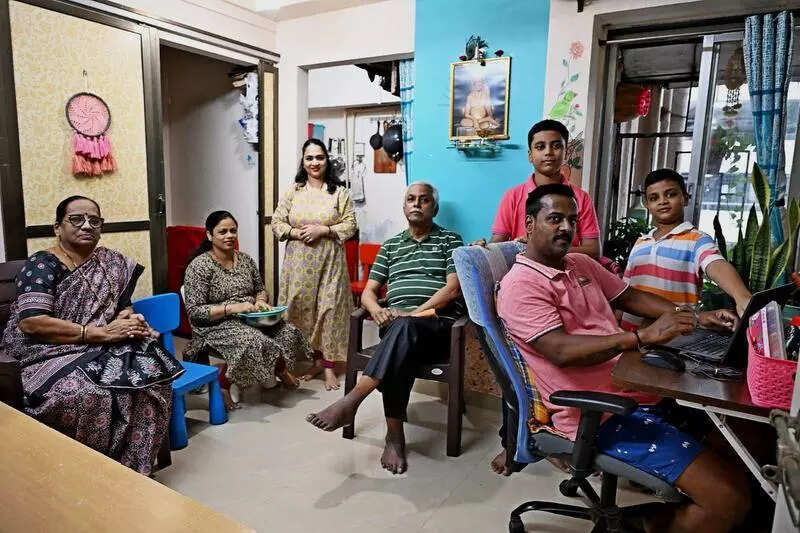
The Nalawade family, with multiple earners, has allocated a budget for new furniture and kitchenware, including a dishwasher and dining table. “Those items just didn’t fit in our old home,” explains Siddhesh Nalawade, 38, who works in translation.
The Nalawades will be given two flats in exchange for the two rooms they previously occupied in BDD, although the family of eight is still deliberating who will reside where. “My brother and I will flip a coin for the apartments, which are on the 20th and 31st floors,” he laughs. “Our parents, Santosh and Anjali, have already decided on the 31st floor since many of our former neighbors are there.”
Like many, the family has mixed emotions about the transition. They look forward to the spacious new apartment but feel nostalgia for the BDD chawls that served as their family’s anchor in Mumbai. “My grandfather rented a room in BDD when he arrived from Malvan for work at Worli’s Madhusudan Mill. Four generations have lived here. Now, for the first time, we’ll be living apart, even in the same building,” reflects Nalawade.
Rupali Rane, 60, says she hasn’t made any specific arrangements for the new apartment as her four daughters will handle the decor. “They plan to send me to my sister’s house during the setup,” she smiles, “They want everything new for the new space.” Rane is an activist with the Akhil BDD Chawl Bhadekaru Hakka Saurakshan Samiti, a tenant group advocating for redevelopment. She mentions that an orientation event arranged by Tata Housing and Mhada provided insight into ‘tower life,’ including the new building regulations.
She lists some of the rules: “Keep shoes and personal items out of corridors; celebrations must occur down by the building, not in the corridors; garbage must be sorted; private electrical connections aren’t allowed from corridor lights; and pets are prohibited in the apartments. I think these rules are sensible.”
Kiran Mane, 59, general secretary of the Akhil BDD Chawl Bhadekaru Hakka Saurakshan Samiti, points out that while losing the BDD chawls represents the end of a unique social heritage, one should not dwell too much on sentiment. “The chawls were challenging to live in. They were dirty, dilapidated, had water shortages, and sometimes faced violence. The new flats symbolize the fruition of a 25-year struggle for an improved lifestyle. It feels like a dream fulfilled at last.”