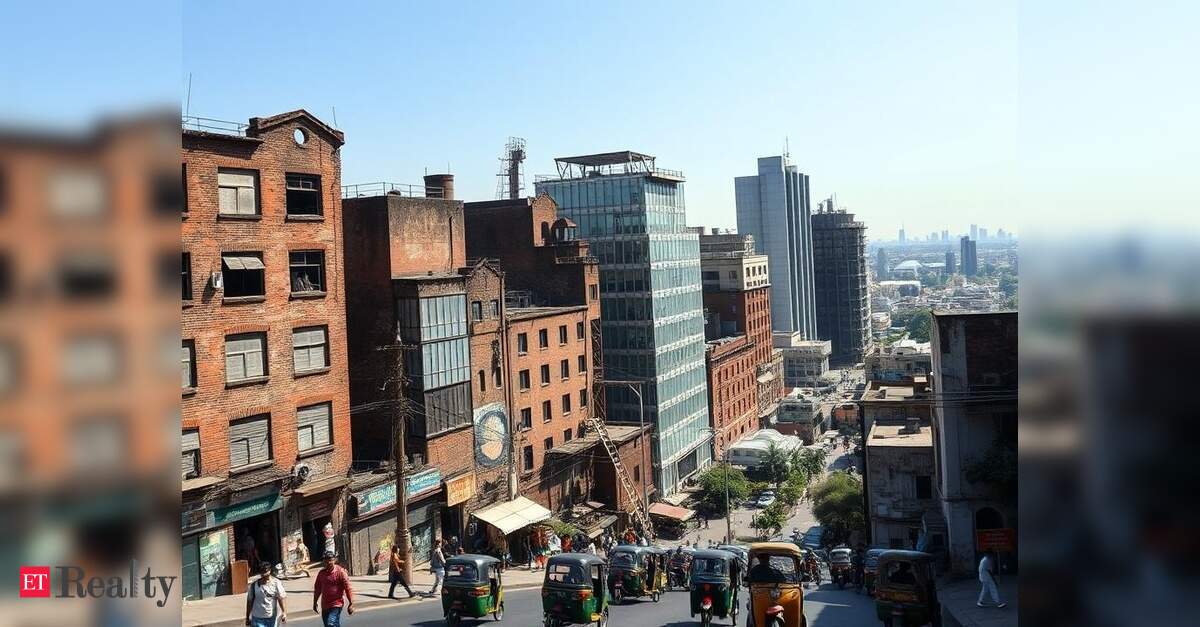

NASHIK: Redevelopment in Nashik has gained significant traction over the past few years, with more than 16,000 old properties demolished and redeveloped in just seven years, according to data from the Nashik Municipal Corporation (NMC).
According to NMC, a total of 29,222 properties have been redeveloped in the last two decades. The last seven years alone saw 16,000 older properties being modernized, reflecting a notable upsurge in construction activities as both residents and developers choose to replace outdated structures with new ones, featuring advanced amenities.
An annual average of about 2,500 structures, mainly old houses, bungalows, and small residential buildings, have been redeveloped over the past five years. Most of these properties are between 30 and 40 years old and are categorized as structurally weak or outdated.
As infrastructure deteriorates and safety concerns increase, many homeowners view reconstruction as a long-term investment, enhancing both safety and property values.
According to officials, revisions in planning regulations have significantly influenced the pace of redevelopment. The introduction of unified Development Control and Promotion Regulations (DCPR) in 2020 included liberalized FSI norms, premium FSI, and the utilization of Transferable Development Rights (TDR). The rising land prices and demand for amenity-rich, multi-storey residences further incentivized developers to replace older low-rise buildings with taller ones, yielding better returns and improved living standards.
Civic records reveal the extent of aging properties in Nashik: approximately 25,000 structures are over 60 years old, and another 28,971 fall within the 40 to 60-year range. Additionally, over 100,000 properties in the city are between 15 and 40 years old, demonstrating a significant potential for redevelopment as Nashik continues to evolve.
Uday Ghuge, the vice-president of the Confederation of Real Estate Developers Association of India (Credai) Nashik, commented that historical settlement patterns in Nashik have been characterized by horizontal expansion. “For the past 30 to 40 years, standalone houses, bungalows, and small multi-storey buildings have proliferated throughout the city. However, with land prices rising and an increased demand for apartments, redevelopment has become the practical approach,” he explained.
Ghuge elaborated that prior to the unified DCPR, the basic FSI available was only 1, with a potential 0.40 through TDR, limiting redevelopment opportunities. “The 2020 unified DCPR introduced more premium FSI options. On a 9m-wide road, the total permissible FSI, including TDR and premium FSI, is now 3.2, and 4.8 on a 30m road. This has triggered extensive redevelopment of older properties in recent years,” he stated.
He also noted that Nashik has over 6,000 housing societies and apartment complexes along 9m roads, many of which are several decades old and in urgent need of redevelopment. However, he pointed out that the FSI granted in Nashik remains lower than that in Thane and Pune, making some redevelopment projects financially challenging. “We are engaging with the state government to seek an additional 0.5 FSI in line with Thane and Pune, which would significantly boost redevelopment efforts,” Ghuge added.