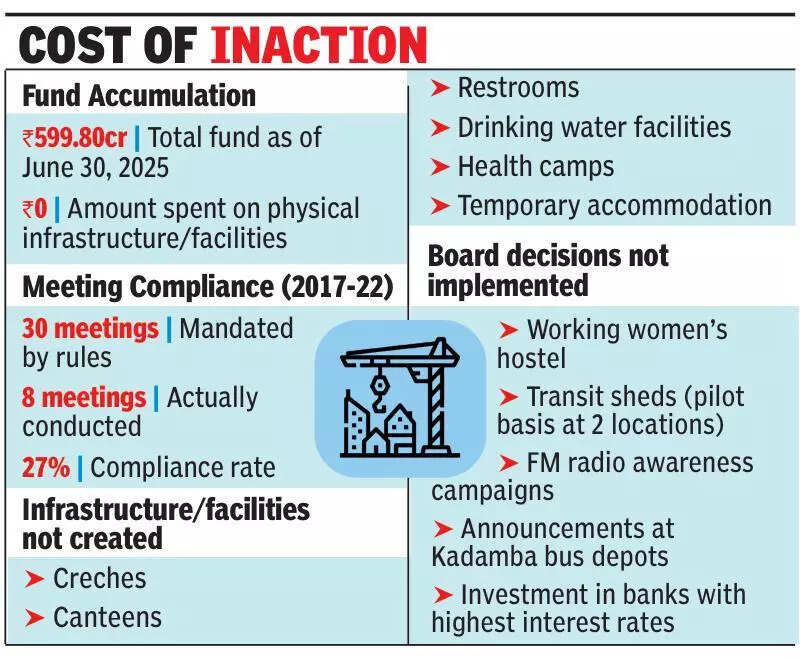
MARGAO: Despite accumulating ₹600 crore under the Building and Other Construction Workers Welfare Fund by June 2025, official data obtained by TOI indicates that not a single rupee has been allocated for basic infrastructure or facilities for construction workers.
Data from the labor and employment department reveals that although funds have been allocated for various welfare schemes, no spending has occurred on critical amenities such as crèches, canteens, rest areas, drinking water facilities, health camps, or temporary accommodations as mandated by the Act.
The Goa Building and Other Construction Workers Welfare Board was established in July 2008 under the guidance of the labor minister, following the Building and Other Construction Workers Welfare Act of 1996.
Furthermore, a recent performance audit led by the Comptroller and Auditor General of India highlighted systemic failures in executing welfare initiatives. The audit noted that “social security and welfare schemes for building and construction workers were poorly executed,” resulting in the collection of a cess that remained largely unspent.
While some schemes were operational, others had significantly low beneficiary numbers, indicating a failure to reach eligible workers.
Notably, the board did not follow through on its own recommendations. The audit report revealed that critical decisions—like establishing working women’s hostels and transit sheds, conducting awareness campaigns via FM radio, and maximizing interest on investments—were not implemented.
The audit explicitly stated that the “non-implementation of board decisions contravened the rules and undermined the board’s authority.”
Worker registration remains alarmingly low due to insufficient outreach efforts. The audit found a lack of a systematic approach to identify unregistered establishments, leaving many eligible workers without social security coverage. The board failed to run awareness campaigns to encourage registrations.
Additionally, from 2017 to 2022, the board convened only eight meetings out of the required thirty, reflecting a mere 27% compliance rate. This impacted the board’s effectiveness in implementing welfare schemes, registering beneficiaries, and conducting awareness initiatives.
Staff shortages have exacerbated operational challenges. The audit recommended that the state government ensure adequate personnel are in place for effective functioning and to fulfill the board’s mandate.